Showing posts with label 51e Hainault. Show all posts

Monday, August 29, 2011

St. Kitts (9): The Limits of Endurance

This is the ninth entry in a series of posts on the St. Kitts campaign of 1782. The St. Kitts campaign took place in what is known as the West Indies theater of the Revolutionary War. [Click for Part 1, Part 2, Part 3, Part 4, Part 5, Part 6, Part 7, or Part 8].

Standoff at Sea

After failing to defeat the British fleet on January 26th, the Comte de Grasse (at right) kept the British navy hemmed in along the southeastern coast of St. Kitts. Each day, the French ships came within sight of the British fleet, and more it looked as if a major attack might commence. The only real combat that occurred, however, was an occasional clash involving a few frigates, schooners, or other, smaller vessels. [1]

De Grasse was frustrated with this business. His fleet had no proper anchorage, and the constant patrols at sea wore down his ships and crew. His vessels ran out of their original store of provisions in early February, and the crews then subsisted on provisions seized or commandeered from merchant ships. The French fleet was also low on ammunition after the several battles with the British on January 25th-26th. De Grasse seems to have feared being caught in this situation once an expected British reinforcement (Admiral George Rodney’s squadron) arrived and made the British fleet larger than his own. [2]

Around the time that the original provisions gave out, de Grasse was arguing that the further prosecution of the siege was inadvisable. However, the Marquis de Bouillé, who commanded the French troops on land, was determined to continue. Through some mysteries grapevine, the British naval officers almost immediately learned of this division and it gave them fresh hope. On February 8th, Captain Robert Manners of the Resolution wrote:

I understand the French commanding officers are all at variance. De Grasse is not for risking his squadron, probably wishing to preserve it for the more important conquest of Jamaica. The Marquis de Bouille declares he will not give the island up, though Dr Grasse should leave him, and [Comte de] Bougainville sides with De Bouille… [3]

De Grasse relented and maintained a thankless watch on the British fleet.

Battered Brimstone Hill

The Marquis de Bouillé’s determination to maintain the siege was well founded. On land the French were at last making good progress battering Brimstone Hill into submission.

On the night of January 31st, French infantry found at the base of Brimstone Hill a large, abandoned cache of artillery. This included eight brass 24-pounders, with 6,000 cannonballs, and two brass 13-inch mortars, with 1,500 shells. These guns had been part of the “travelling artillery of the West Indies,” kept in storage on St. Kitts. As the artillery belonged neither to the British garrison, nor to the island’s militia, neither had thought to remove the guns and mortars to a more secure location when the French invasion began. This windfall allowed the ammunition-starved French army to escalate its bombardment of the British garrison. [4]

A few days later (February 3), de Bouillé was reinforced with a battalion of Regiment Hainault, dispatched from Grenada. Also, the ship of the line Caton lent two of its 18-pounders and ten of its 24-pounders to the besieging army. [5]

----------------------------------------------------

The Marquis de Bouillé (at center, holding sword) at the siege of Brimstone Hill. In the background are burnt-out houses in the town of Sandy Point. At right, a mortar battery fires on the hill. (Excerpt of a French illustration).

Artillery are dragged forward during the siege of Brimstone Hill. (Excerpt of a French illustration).

----------------------------------------------------

The British naval commander, Vice Admiral Samuel Hood, could do little to aid the garrison. Brigadier-General Robert Prescott had returned to Antigua after the inconclusive battle on January 28th. Hood wrote that on February 8th, he was informed by signals from Brimstone Hill “that the enemy’s batteries had been successful in damaging the works and buildings [on the hill], [and] that the garrison was reduced and short of ordnance stores.” Therefore, he dispatched several officers to provide moral support to the garrison, but although the men went at night and worse disguises, all were captured. [6]

By February 11th, the state of the garrison had grown quite grim. Governor Thomas Shirley noted in his journal:

[The French] opened a battery of 4 guns near… the foot of the Hill, against the north-west front, from whence they very much annoyed the garrison on the highest parts. Twenty-three pieces of cannon and all their mortars were this day incessantly played upon the Hill, whereby the breaches already made were greatly widened and the garrison became much reduced by killed and wounded. [7]

Matters were even worse on the 12th. Shirley wrote:

This day, on the northwest front was an entire breach and all the guns disabled. In the curtain were two very large breaches; the whole parapet was destroyed… In the left flank all the guns were disabled and in the left face was a practicable breach of forty feet. [7]

Lieutenant George Lewis Hamilton described the woeful condition of the garrison’s artillery:

Upon our opening the batteries on the lower works, on the first appearance of the enemy, there was two twenty four pounders, four twelve pounders, two nine pounders and one eight inch howitzer mounted… The progress of the enemy, since they have opened their gun batteries, has been so heavy and rapid… that the eight inch howitzer only remains serviceable, and from the present ruinous and exposed state of the whole front[, it] can only be brought into action in the night, when it is supposed that the enemy's fire has abated and they are making approach to assault. [7]

He found the situation to be little better in the upper citadel and concluded that the “guns and carriages… are in the worst state and are absolutely insufficient to prevent the approaches of the enemy.”

The French could clearly see the breeches in the fortress walls, and the Marquis de Bouillé decided to mount an assault. He wrote:

The day of the 13th was to be used to reconnoiter and make dispositions, and the attack was to be on the 14th, one hour before daylight. The Marquis de Chilleau, one of the bravest men that I have known, was to command the head of my attack. The grenadiers and soldiers were full of ardor, and although I assumed that I would lose many, I counted on success. [8]

Notes:

1. John Gilmary Shea (1864). The operations of the French fleet under the Count de Grasse in 1781-2 as described in two contemporary journals; John Ross (1838). Memoirs and correspondence of Admiral Lord de Saumarez, Vol. 1.

2. Shea, ibid.

3. Letters and papers of the Duke of Rutland.

4. The Journal Politique for 1782; Attaque et prise de Saint-Christophe dit le «Gibraltar» des Antilles (janvier-février 1782), in Revue Historique des Armées, Vol. 1, 1974. This article includes extracts from «Mémoires Secrets» de Bouillé; The Remembrancer, Vol. 14.

5. Attaque et prise..., ibid.

6. Attaque et prise..., ibid. Charles Middleton (1907). Letters and papers of Charles, Lord Barham, Volume 1. David Hannay (1895). Letters written by Sir Samuel Hood (Viscount Hood) in 1781-2-3.

7. Algernon Aspinall (1915). West Indian tales of old.

8. Attaque et prise..., ibid. (Translation is my own)

Saturday, July 9, 2011

Uniforms of the St. Kitts Campaign

I'm about halfway through a series of posts on the St. Kitts campaign of 1782 (the most recent post was Part 5). Upcoming posts will focus on a naval engagement on January 26, a land battle on January 28, and the final days of the siege of Brimstone Hill.

As an aside to this series, I discuss in this post the uniforms worn by British and French army regulars during the campaign.

The description that follows touches on only some aspects of the clothing worn by these troops. For a much more complete account, see Philip R. N. Katcher (1973). Encyclopedia of British, Provincial, and German Army Units 1775-1783, and René Chartrand (1991). The French army in the American War of Independence.

British Army

British regulars wore red coats. Individual regiments were distinguished by the color of the coat "facings" (i.e., collar, cuffs, and lapes), by the lace pattern worn around the buttonholes (white with different combinations of colored stripes), and by the metallic color used for officers’ buttons, hat trim, etc. (A copy of the uniform regulations can be found here).

  • 1st (or Royal) Regiment of Foot: Blue facings. Lace pattern was one blue "worm". Officers’ metal was silver.
  • 13th Regiment of Foot: Yellow ochre facings. Lace was worn in pairs; pattern was one yellow stripe. Officers’ metal was silver.
  • 15th Regiment of Foot: Yellow ochre facings. Lace pattern was one mixed yellow and black stripe and one red stripe. Officers’ metal was silver.
  • 28th Regiment of Foot: Bright yellow facings. Lace pattern was one yellow and two black stripes. Officers’ metal was silver.
  • 69th Regiment of Foot: Dull dark green facings. Lace pattern was one red stripe between two green stripes. Officers’ metal was gold.

Perhaps the feature of British army uniforms that is least well understood is the caps and hats worn by the light infantry companies, which were not standardized, and which changed over time. At right is a private of the "picket company" of the 13th Foot, wearing an early version of a light infantryman's cap. The uniform predates the Revolutionary War (by which time picket companies had been replaced by light infantry companies).

British Light Infantry Officer. This officer, thought to have been with the 15th Foot, is wearing a round hat cocked up on the left side and adorned with a feather. This style of hat would have been worn by the light infantry companies of the 15th and 28th regiments during the Philadelphia campaign of 1777, and possibly retained by these regiments after they were sent to the West Indies in 1778. The light infantry company of the 15th Regiment helped garrison Brimstone Hill fortress.

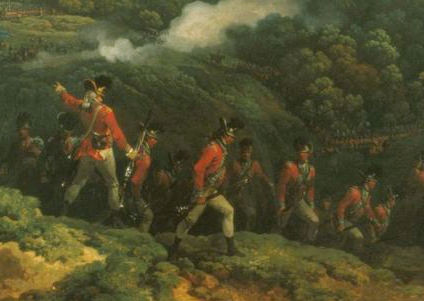
British Light Infantry on Maneuvers. This section of a painting by Philippe Jacques de Loutherbourg shows what may be the light infantry company of the 69th Foot participating in war game exercises in England, circa 1778. The dark green facings and the style of leather cap match known uniform details for this unit.

French Army

Most regiments of the French regular army wore white coats. Individual regiments were distinguished by the combination of facing color on cuffs and lapels, the orientation of the side pocket flaps, and the color of the buttons.

  • Régiment d'Armagnac (6e): Light blue lapels, vertical pocket flaps, white buttons.
  • Régiment de Champagne (7e): Light blue cuffs, vertical pocket flaps, white buttons.
  • Régiment d'Auxerrois (12e): Black lapels, vertical pocket flaps, white buttons.
  • Régiment d'Agénois (16e): Violet cuffs, horizontal pocket flaps, yellow buttons.
  • Régiment de Touraine (34e): Pink cuffs, vertical pocket flaps, white buttons.
  • Régiment d'Hainault (51e): Crimson cuffs, vertical pocket flaps, white buttons.
  • Régiment Royal Comtois (76e): Blue cuffs, vertical pocket flaps, white buttons.
  • Régiment de Dillon (90e): Red coats, yellow cuffs and lapels, horizontal pocket flaps, yellow buttons set in herringbone fashion. At right is a 1779 illustration of a chasseur of this regiment.

Several units of French colonial troops also participated in the St. Kitts campaign. Régiment de la Martinique wore blue coats without lapels and with buff cuffs and collars. Régiment de la Guadeloupe were dressed similarly, but had crimson cuffs and collars. The Volontaires de Bouillé wore a distinctive "blue short coat" with "red cuffs," and a "helmet" (per Chartrand, 1992). Hussars of the 1st Legion of the Volontaires étrangers de la Marine were also present. These wore a uniform similar to that of the well-known Lauzun's Legion.

Regulation uniforms for grenadiers of regiments Hainault (left) and Touraine (right). Note the facing color is used to line the collar and lapels. The red epaulets and hat tuft identify these men as grenadiers.

Both British and French army units may have modified their clothing in various ways. One well-known example of this in the French case is that some (and possibly many) grenadier companies wore bearskin caps rather than the proscribed cocked hats.

Grenadiers of Régiment de Soissonnois in 1781.

A series of images by Nicolas Ponce suggests that chasseur companies also deviated from the regulated headgear. In these images, the chasseurs are shown wearing a round hat that is cocked in the back and adorned with a feather. This style seems practical; unfortunately, I have not come across any evidence to date that corroborates the accuracy of this depiction.

Chasseurs of Régiment de Dillon at the capture of St. Eustatius in 1781.

Monday, March 28, 2011

Life and Death in the Metropolitan Army

The French metropolitan army was the backbone of the French army – the “white coat” counterpart to the British “redcoat.” Americans familiar with the French role during the Revolutionary War are probably most familiar with the army commanded by Comte de Rochambeau that helped win a pivotal victory at Yorktown. However, a much larger proportion of the French army served further to the south, in the West Indies [1]. There, regiments were used to garrison important islands, to serve as shipboard marines [2], and to mount attacks on British-held islands. A few regiments (e.g., Auxerrois, Armagnac, and Dillon) were repeatedly used when the French took the offense. But for even those regiments that mainly spent the war in garrison, the West Indies was an extraordinarily dangerous place. The chief danger, it seems, was disease. Epidemics – which were not uncommon – could kill hundreds of men within a few months, and no army was spared.

Recently I spent some time examining transcribed records to get a better sense of the dangers faced by metropolitan army units serving in the West Indies. The records appear in Les combattants francais de la guerre americaine, 1778-1783 (1905), and include such information as when a soldier enlisted, when and where he died, and (if he survived) when he was discharged from the service [3].

Sample of the records for the grenadiers of Régiment Foix

I then charted the results from a small sample of four infantry companies in order to track life and death in these units over time. I expected to find a significant incidence of mortality in each unit, but I didn’t know how that mortality would be patterned. Would there be a sudden spike in mortality once the unit arrived in the West Indies? Would disease instead be a constant companion, leading to a steady loss of men over time? Or would mortality from disease be relatively unpredictable?

I found, in this small sample, no evidence that regiments began to suffer appalling casualties from disease upon arrival in the West Indies. Instead, disease outbreaks seem unpredictable, beyond perhaps an association with major troop movements (such as the return of d’Estaing’s force to the West Indies from Georgia in late 1779, and the assembly of a large army on Haiti in the Spring of 1782). For each company, the analysis spans the period from May, 1778, to January, 1784. The charts shows the number of enlisted men with each company on a month-by-month basis.

Fusilier Compagnie de Manoel, Régiment Hainault

  • A -- August 16, 1778: The company is in combat for the first time in an engagement between the British Isis and the French César in waters off Rhode Island. Four men are killed in action, and the company is at 94% of its original strength by the end of the month.
  • B -- December, 1778: The company arrives in the West Indies aboard the fleet of Charles-Henri d'Estaing. The company is present at the December 18, 1778, battle of La Vigie, but they are only lightly engaged (1 killed in action). In the following months, enlisted men begin dying at a rate of about 1 per month.
  • C -- October, 1779: The company participates in the siege of Savannah, including the bloody assault on the Spring Hill redoubt. Nine enlisted men die this month (including 5 on the day of the assault). The company is at 76% of its original strength by the end of the month.
  • D -- December, 1779: This month there appears to be an outbreak of sickness while the company is on Grenada. Five men die in December, 8 in January, 4 in February. By the end of February, the company is at 61% of peak strength. The 17 men who perish during this period represent 14% of the company's original complement.
  • E -- January, 1784: A number of men are struck from the company list this month. (Not clear to me is if these men were discharged or if their deaths during the war was belatedly acknowledged). This reduction brings the company down to 40% of its original strength.

Grenadier Compagnie de Pecomme, Régiment Gatinois

  • A -- August, 1779: The company occasionally gains new recruits during this period. Four enroll in August, 1779, bringing the company to a peak strength of 103 enlisted men.
  • B -- October, 1779: The company is spared from the horrific assault on Savannah’s Spring Hill redoubt. (The chasseur company, however, does take severe losses). One death is recorded this month.
  • C -- February, 1780: The disease outbreak that took a heavy toll on Régiment Hainault appears to have affected Gatinois as well. Four enlisted men's deaths are recorded this month.
  • D -- October, 1781: The company is present at the siege of Yorktown, and the grenadiers lose 4 men killed outright during the assault on Redoubt #9, and an additional 3 men at other points during the siege. Several deaths are also reported in Virginia in November -- probably from men that fell ill or that succumbed to their wounds. The losses reduce the company to 79% of its peak strength.
  • E -- August, 1782: Three enlisted men die during what is perhaps another period of illness. The company falls to 73% of peak strength.
  • F -- April, 1783: A number of enlisted men transfer to the French colonial Régiment du Cap (Probably it is their intention to remain in the West Indies beyond the conclusion of the war).
  • G -- August, 1783: The war is effectively over, and many of the enlisted men are discharged. The discharges occur in waves, with the largest number (13) occurring in August, 1783.

Chasseur Compagnie d'Artel de Veinsberg, Régiment Touraine

  • A -- July, 1781: The company reaches a peak strength of 125 enlisted men.
  • B -- October, 1781: The company is present at the siege of Yorktown, but no deaths are recorded among the enlisted men.
  • C -- January, 1782: Five deaths are reported this month; three occur on Martinique and are likely due to illness, the other two are combat fatalities on St. Kitts
  • D -- June, 1782: The company is transferred to Cap François (Haiti). En route the company is present at the battle of The Saintes (April 9 & 12), but the vessel carrying them is not heavily engaged and only 1 death is recorded. Severe illness strikes the company at the Cap starting in June.
  • E -- October, 1782: The main period of illness at Cap François ends. From May to November, the company suffered 28 deaths, reducing it to 68% of peak strength. Nearly 1/3 of the company died in a little more than 1 year, and only three or four of those deaths appear to be combat related.
  • F -- January, 1783: Five more deaths are recorded at Cap François in the first part of 1783. Other reductions in strength after this time are due to men being discharged.

Compagnie de Sigoyer Grenadiers, Régiment Foix

  • A -- March, 1779: The company reaches a peak strength of 98 enlisted men.
  • B -- October, 1779: Seven enlisted men die during the month of October. The company participates in the siege of Savannah (including the assault on the Spring Hill redoubt), but most of the deaths appear to be due to illness, including several among ill men that were left behind on the island of Martinique.
  • C -- December, 1779: Seven enlisted men die during the month of December. The deaths occur on the islands of Martinique, St. Vincent, and Grenada, and also at sea. Either the company has been divided among several posts, or the company has left sick men at each of several places it has been stationed. At the end of the month, the company is down to 81% of peak strength.
  • D -- April, 1782: Two enlisted die aboard the Magnanime during naval operations
  • E -- July, 1783: A handful of men are struck from the rolls or are discharged; discharges continue as the war winds down.

----------------------------------------------------

Notes:

1. For an excellent history, see René Chartrand (1992). The French army in the American War of Independence.

2. Such troops were used to board enemy vessels, repel boarders from enemy vessels, and to fire on the gunners serving enemy vessels.

3. I was of course working under the assumption that these records are accurate and complete for these companies (a difficult point to gauge).