Showing posts with label Sorel. Show all posts

Saturday, March 19, 2011

Surrender at Lavaltrie

This is the most recent entry in a series of posts on the American invasion of Canada. The previous post can be found here. For an index of all posts, see here.

British Governor Guy Carleton abandoned Montreal on November 11, 1775, and headed for Quebec. Carleton sailed with an 11-vessel flotilla that included the British regulars that had garrisoned Montreal. The flotilla reached Sorel on the 15th, where they found their passage blocked by American forces under Colonel James Easton. Easton had placed a 12-pounder gun was placed in a gondola that was rowed out into the shipping channel. He also had on shore one battery of two 6-pounders, and another of one 9-pounder and three 12-pounders. Overseeing the guns was Lieutenant Martin Johnston of Lamb’s artillery company.

When the British vessels neared these guns, the Americans fired seven cannon balls into the lead vessel (probably the Gaspee), causing havoc on board [1]. According to Benjamin Trumbull, the British then attempted to land some of “their men and Effects,” but they were thwarted by Canadian volunteers allied with the Americans. The flotilla then turned about and anchored upstream.

Easton sent a message to Carleton, in which he gloatingly wrote, “You are very sensible I am in Possession at this Place, and from the Strength of the United Colonies on both sides, your own situation is Rendered very disagreeable.” He warned that if Carleton did not surrender, “you will cherefully take the Consequences which will Follow.”

Soon thereafter, Easton advanced some guns close to the British anchorage, and forced them to retreat still further upstream. This time they anchored near Lavaltrie.

From Sorel to Lavaltrie. The routes taken by the American forces are conjectural.

When American Brigadier-General Richard Montgomery learned that Carleton had been trapped, he asked Colonel Timothy Bedel to take his regiment (Bedel’s Rangers) and the Green Mountain Boys to Easton’s assistance. As an incentive to the troops, he offered them “All public stores, except ammunition and provisions.” Bedel’s men chose to march; the Green Mountain Boys did not.

At Lavaltrie, Governor Carleton weighed his options. The wind was still not in his favor, and the Americans were closing in. He accepted the offer of one of his Canadian ship captains (Bouchette) to lead him past the Americans in a small boat. Carleton then ordered Brigadier-General Richard Prescott to make his way as best he could with the flotilla. As a last resort, Prescott was to throw his guns and gunpowder overboard and surrender.

On the night of November 16-17, Captain Bouchette, Governor Carleton, and two of Carleton’s aides (de Lanaudière and de Niverville) rowed quietly downstream (the oars were wrapped in cloth to dampen the noise). When their boat neared the Americans, the men silently paddled with their hands. By morning, they were well out into Lac Saint Pierre. Carleton reached Quebec on the 20th.

Prescott did not attempt a breakout, and on the 19th he agreed to surrender. The Americans thus captured 11 officers, 9 sergeants, 5 drummers and fifers, 113 rank and file, a large number of sailors, some prominent French and English Canadians, and a few artillerymen. Also on board was a large supply of provisions, including 760 barrels of pork and 675 barrels of flour. Prescott had most of the gunpowder thrown overboard, but the Americans still captured much-needed ordinance and ammunition [2].

In this manner, the Americans finished off the 26th Regiment of Foot, and Montgomery obtained the means to convey his army from Montreal to Quebec. Montgomery was astonished by the ease of this victory, writing “I blush for His Majesty's troops! Such an instance of base poltroonery I never met with!”

Notes:

1. As was the case with the attack on the Fell, I’m unsure how many casualties were inflicted. At least one soldier was killed -- a sergeant in the 26th Regiment (see here).

2. Most of the infantry were from the 26th Regiment; the rest were odds and ends of the 7th Regiment and the Royal Highland Emigrants. Click on the following links for a tally of the loss in officers, enlisted men, ordinance, and provisions.

Sunday, March 6, 2011

Struggle for Sorel

This is the most recent entry in a series of posts on the American invasion of Canada, for an index of past posts, see here.

Sorel was occupied by British Lieutenant-Colonel Allan Maclean in mid-October, 1775. Maclean’s force consisted of 120 men of the newly-raised Royal Highland Emigrants, 60-some men of the 7th Foot, and a number of Canadian militia. Maclean brought these men from Quebec with the intention of aiding in the relief of Fort Saint-Jean. He advanced up the Richelieu as far as Saint-Denis, where he found that a key bridge had been cut. Some local Canadians were welcomed into his camp, but these men then slipped away at the first opportunity – taking arms and ammunition with them. Maclean returned to Sorel and awaited the advance of Governor Guy Carleton’s force from Montreal.

Carleton’s army was defeated at the battle of Longueuil, which ended hopes of relieving Fort Saint-Jean. Maclean’s militia returned home once the dispiriting news was received. Maclean returned to Quebec soon thereafter, but he left behind an armed vessel (the Fell) and the detachment from the 7th Foot. Their task was to keep communications open between Montreal and Quebec.

Fort Saint-Jean formally surrendered on November 3rd. The victorious American commander, Brigadier-General Richard Montgomery then launched two strikes designed to capture British Governor Guy Carleton and the British garrison defending Montreal. The first strike was led by Montgomery himself, and was aimed directly at the city. The second strike was led by Colonel James Easton, and was aimed at taking Sorel. Montgomery hoped that Easton would cut off Carleton’s escape route to the east.

Montreal Campaign, Early November (click to enlarge).

Easton’s force consisted of his own regiment of New England provincials, and James Livingston’s Canadian Volunteers. These men were in Saint-Ours by November 3rd, and Sorel by the 7th. The British troops there stayed aboard the Fell, nearly 200 yards offshore. To defeat this force, Easton ordered a battery of two 6-pounders to be constructed on shore.

On the morning of November 8th, Easton’s guns opened fire. The Fell quickly cut its cables and moved downstream, but in the meantime, according to American Major John Brown, “we plumped her through in many places” with “at least twelve rounds.” Brown [1] relished hearing civilians on board crying out “O Lord! O Lord!” as the Americans blasted away. Two sailors on the Fell were wounded: William Money "had his thigh broke... by a Cannon Shot" and William Wadlow "had his right Breast shot off by a cannon shot" [2]. The Fell’s return fire missed the battery and landed in the village instead.

It was a small victory, but now Easton could lay a trap for Guy Carleton’s men.

Notes:

1. It is remarkable how active the unheralded Brown was in this campaign. Brown tried to enlist the support of the Canadians for the American cause prior to the start of the Revolutionary War (discussed here). Then Brown participated in the capture of Fort Ticonderoga in May, 1775. Brown later became second in command of Easton’s regiment, but he was active in Montgomery’s operations before Easton arrived in Canada. As described in previous posts, Brown captured supplies bound for Fort Saint-Jean, fought the British at Rivière Saint-Jean, captured the village of La Prairie, conspired with Ethan Allen before the debacle at the battle of Longue-Pointe, and played a leading role in the capture of Fort Chambly.

2. There may have been other casualties – these two men were identified in a return of losses (signed by Hector de Cramahé and dated May 25, 1776) among Royal Navy personnel during the invasion of Canada.

Friday, February 18, 2011

Montreal Campaign: Index

Below is a listing of blog posts I’ve written concerned with the operations of Brigadier-General Richard Montgomery’s operations in Canada in 1775 – especially the siege of Fort Saint-Jean and the subsequent capture of Montreal.

General:

The Invasion Begins:

Battle of Longue-Pointe (September 25, 1775)

Battle of Longueuil (October 30, 1775)

The Siege of Fort Saint-Jean (September 17-November 3, 1775)

Fight at Sorel (November 8 & 15, 1775)

Epilogue: Triumph & Tragedy

Some Military Units:

Sunday, November 21, 2010

Guy Carleton vs. Ethan Allen

This is another installment in my ongoing series on the American invasion of Canada in 1775.

Governor Guy Carleton made Montréal his headquarters after the Americans began to invade Canada. The colony’s chief defense was Fort Saint-Jean on the Richelieu, where the bulk of the 7th and 26th regiments was garrisoned. Once that fort was besieged, Carleton placed his hopes in raising a large body of Canadian militia to relieve the fort, or to at least prevent the Americans from making any further inroads into Canada. However, the rebellion of Canadian forces in the Richelieu valley and forays made by Colonel Ethan Allen and Major John Brown dashed Carleton’s hopes. On September 21, 1775, he bemoaned [1] that “A few days ago I had hopes of assembling a corps on the Sorell [i.e., the Richelieu river] and another at La Prairie, either of which might have saved the province for this year, but the friends of rebellion dissipated both by their intrigues and lies” (Allen helped capture Carleton’s agents on the Richelieu, and Brown captured La Prairie; cf. here). He determined, however, to “spin out matters as long as I can in hopes that a good wind may bring us relief” (i.e., until reinforcements should arrive from Boston or Britain).

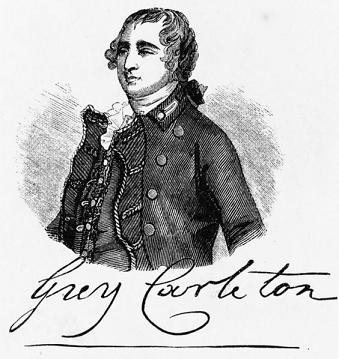
Guy Carleton

In practice, this meant that Carleton remained holed up in Montréal while awaiting events. Carleton had with him a detachment of the 26th Regiment, some Indian Department officers and [Guy] “Johnson’s rangers,” and a small number of Indians. Montréal was a walled city, but Carleton took little comfort in this as the walls were “extensive and defenceless.” The town’s primary defense was its Canadian and English militia. The upper class of Canadians seemed dependable; already a number of these men were serving with the garrison at Fort Saint-Jean. The lower class, however, were at best ambivalent in their sentiments, and quite a few of the English citizens of Montréal had strong ties to the Thirteen Colonies and preferred the American cause.

Meanwhile, Colonel Ethan Allen was heading his way.

Allen distinguished him by co-leading the successful attack on Fort Ticonderoga. However, he afterwards led a meaningless expedition into Canada that almost got him and his command killed or captured [see events of May 17 and May 18, 1775]. (This misadventure in Canada was a primary reason why Allen was bypassed for the leadership of the Green Mountain Boys, when they organized as a regiment in the Continental Army).

A correspondent for the New York Gazette observed that “Allen is a high flying genius, pursues every scheme on its first impression, without consideration, and much less judgment. It was with the utmost difficulty, and through the greatest entreaty, that [Major] General [Philip] Schuyler permitted him to go with the army, knowing his natural disposition…” [2]

Allen's Route to Longue-Pointe: September 18-24, 1775 (click to enlarge).

On September 18, Allen was at Saint-Denis, and contemplated capturing some British vessels anchored at Sorel. On the 20th he was at Saint-Ours, with, he claimed, 250 newly-raised volunteers. He boasted in a letter to Brigadier-General Richard Montgomery that he would raise hundreds, if not thousands, of men, and join Montgomery's army then besieging Fort Saint-Jean. [3] Soon thereafter, Allen marched to Sorel, but made no attempt to capture the British vessels. Instead, his force turned towards La Prairie. Allen could not pay, or feed, or arm his men, and only about 80 left the Richelieu valley with him. Those that did allegedly “plundered the Houses and Farms of the Gentlemen and Habitants, that had joined the King's Forces” “in every Parish on their Road.” [4]

On September 24, Allen’s party left Longueuil for La Prairie, marching along the stretch of St. Lawrence opposite Montréal. En route, he encountered Major Brown. According to Allen, “Col. Brown proposed that, "provided I would return to Longueuil, and procure some canoes, so as to cross the river St. Lawrence a little north of Montreal, he would cross it a little to the south of the town, with near two hundred men, as he had boats sufficient; and that we could make ourselves masters of Montreal."” [5] Allen quickly agreed, picked up 30 Americans that had been with Brown, and returned to Longueuil. His party crossed the river that night and landed in an area known generally as Longue-Pointe. [6]

Notes:

1. Letter to William Legge, Secretary of State for the Colonies, dated September 21, 1775.

2. In Frank Moore (1859). Diary of the American Revolution: From newspapers and original documents.

3. The full contents of Allen's letter can be found here.

4. Here I am quoting a letter by Hector de Cramahé, lieutenant governor of the province of Quebec.

5. From Allen's narrative.

6. As shown in the map, Allen landed in a rural area considerably above the "village" of Longue-Pointe. The landing site was almost certainly within the modern-day Hochelaga-Maisonneuve district of Montréal.