Showing posts with label 26th Foot. Show all posts

Saturday, March 19, 2011

Surrender at Lavaltrie

This is the most recent entry in a series of posts on the American invasion of Canada. The previous post can be found here. For an index of all posts, see here.

British Governor Guy Carleton abandoned Montreal on November 11, 1775, and headed for Quebec. Carleton sailed with an 11-vessel flotilla that included the British regulars that had garrisoned Montreal. The flotilla reached Sorel on the 15th, where they found their passage blocked by American forces under Colonel James Easton. Easton had placed a 12-pounder gun was placed in a gondola that was rowed out into the shipping channel. He also had on shore one battery of two 6-pounders, and another of one 9-pounder and three 12-pounders. Overseeing the guns was Lieutenant Martin Johnston of Lamb’s artillery company.

When the British vessels neared these guns, the Americans fired seven cannon balls into the lead vessel (probably the Gaspee), causing havoc on board [1]. According to Benjamin Trumbull, the British then attempted to land some of “their men and Effects,” but they were thwarted by Canadian volunteers allied with the Americans. The flotilla then turned about and anchored upstream.

Easton sent a message to Carleton, in which he gloatingly wrote, “You are very sensible I am in Possession at this Place, and from the Strength of the United Colonies on both sides, your own situation is Rendered very disagreeable.” He warned that if Carleton did not surrender, “you will cherefully take the Consequences which will Follow.”

Soon thereafter, Easton advanced some guns close to the British anchorage, and forced them to retreat still further upstream. This time they anchored near Lavaltrie.

From Sorel to Lavaltrie. The routes taken by the American forces are conjectural.

When American Brigadier-General Richard Montgomery learned that Carleton had been trapped, he asked Colonel Timothy Bedel to take his regiment (Bedel’s Rangers) and the Green Mountain Boys to Easton’s assistance. As an incentive to the troops, he offered them “All public stores, except ammunition and provisions.” Bedel’s men chose to march; the Green Mountain Boys did not.

At Lavaltrie, Governor Carleton weighed his options. The wind was still not in his favor, and the Americans were closing in. He accepted the offer of one of his Canadian ship captains (Bouchette) to lead him past the Americans in a small boat. Carleton then ordered Brigadier-General Richard Prescott to make his way as best he could with the flotilla. As a last resort, Prescott was to throw his guns and gunpowder overboard and surrender.

On the night of November 16-17, Captain Bouchette, Governor Carleton, and two of Carleton’s aides (de Lanaudière and de Niverville) rowed quietly downstream (the oars were wrapped in cloth to dampen the noise). When their boat neared the Americans, the men silently paddled with their hands. By morning, they were well out into Lac Saint Pierre. Carleton reached Quebec on the 20th.

Prescott did not attempt a breakout, and on the 19th he agreed to surrender. The Americans thus captured 11 officers, 9 sergeants, 5 drummers and fifers, 113 rank and file, a large number of sailors, some prominent French and English Canadians, and a few artillerymen. Also on board was a large supply of provisions, including 760 barrels of pork and 675 barrels of flour. Prescott had most of the gunpowder thrown overboard, but the Americans still captured much-needed ordinance and ammunition [2].

In this manner, the Americans finished off the 26th Regiment of Foot, and Montgomery obtained the means to convey his army from Montreal to Quebec. Montgomery was astonished by the ease of this victory, writing “I blush for His Majesty's troops! Such an instance of base poltroonery I never met with!”

Notes:

1. As was the case with the attack on the Fell, I’m unsure how many casualties were inflicted. At least one soldier was killed -- a sergeant in the 26th Regiment (see here).

2. Most of the infantry were from the 26th Regiment; the rest were odds and ends of the 7th Regiment and the Royal Highland Emigrants. Click on the following links for a tally of the loss in officers, enlisted men, ordinance, and provisions.

Sunday, February 13, 2011

Fruits of Victory

The guns at Fort Saint-Jean fell silent late on November 1, 1775. The next day was spent in negotiations, and the formal surrender took place on the 3rd.

The surrender ceremony was brief. At 10 AM the Americans assembled their regiments and marched to within 50 yards of the fort. There, according to an American artilleryman, “we halted and was all drawn up in a rank and stood there till the regulars got ready and marched out with all their arms and 2 field pieces.” [1]

The British troops are then embarked in a number of bateaux and taken into captivity. For them, it is a bitter defeat. One Juchereau dit Duchesnay, a militia officer, wrote bitterly to a friend, “Notre résistance nous a fait obtenir les honneurs de la guerre et la douce satisfaction d'être traînés à Connecticut: un coup de fusil au travers du corps à Montréal me ferait beaucoup moins de peine et de tort.” (Roughly: ‘Our resistance has obtained us the honors of war and the sweet satisfaction of being dragged to Connecticut; a shot through the body in Montreal would cause much less pain and harm’). [2]

The victorious American commander, Brigadier-General Richard Montgomery, soon pressed on to conquer the rest of Canada. By the 7th, most of Montgomery’s men streamed into the village of La Prairie, across from Montreal. On the 11th, a large contingent crossed from La Prairie to L'île St. Paul in the middle of the St. Lawrence. British Governor Guy Carleton realized the futility of trying to hold Montreal any longer, and he embarked the city’s garrison and a large amount of supplies on 11 vessels. Late in the day this flotilla heads down the St. Lawrence towards Quebec.

On the 12th, the city of Montreal entered into surrender negotiations with Montgomery. With Carleton gone, the city walls were defended by local militia. The Montrealers were primarily concerned about property rights and the continued free exercise of religion. The negotiations proceeded smoothly, and the surrender took place the following day.

Winter weather hit the area at this time, which caused much hardship for the Americans, as recorded by journalists:

  • Aaron Barlow on November 7th: “The weather being cold makes it very uncomfortable living in tents.”
  • Benjamin Trumbull on November 9th: “It begins to rain, the Ways are dirty and Slippery so that it is difficult to Walk without falling. The Whole Country is water and mud & not a dry Spot to be found.”
  • John Fassett on November 12: “Went to a Dutchman’s house to get a dram… where were a number of Yorkers of the First Battalion, cursing and swearing and damning themselves and one another. It seemed like a hell upon earth. Fair weather but cold.”

----------------------------------------------------

While working on this project, I've painted a number of 15mm miniatures to represent soldiers from the British garrison and the American army. Some of these appeared in past posts; here are some that I don't believe I've posted before.

The Garrison. Pictured are troops of the 26th Foot, an officer of the 7th Foot with a brass 24-pounder, a Royal Artillery officer, and the officer's wife.

The Besieging Army. Pictured are one of Lamb's cannoneers with a brass 12-pounder, General Montgomery, and some Connecticut Continentals.

----------------------------------------------------

The victory at Fort Saint-Jean was a remarkable achievement for a Continental army that was not yet 5 months old.

The garrison that surrendered included the following:

  • 7th Regiment of Foot: 259 men [3]
  • 26th Regiment of Foot: 215 men [3]
  • Canadian Gentleman Volunteers, Officers, and Militia: 75 men [4]
  • Royal Artillery: 38 men [3]
  • Royal Highland Emigrants: 19 men [3]
  • Other Canadian Volunteers: 12 men [4]
  • Native Americans: 2 men [4]

In addition to these land forces, the Americans captured a Royal Navy contingent led by Captain Hunter, and a group of carpenters and artificers, led by Captain Thompson.

The Americans also captured the half-sunk Royal Savage, a row galley, a number of smaller vessels, and a large train of artillery.

Notes:

1. From the “True journal of Barwick’s Company from New York to Quebec, August 4, 1775 to September 25, 1776.” Robert Barwick was a cannonneer in Lamb’s artillery.

2. From Hospice-Anthelme-Jean-Baptiste Verreau's (1873) Invasion du Canada.

3. From a return dated November 1, 1775, at Fort Saint-Jean. Published in A history of the organization, development and services of the military and naval forces of Canada from the Peace of Paris in 1763 to the present time. Vol. 1.

4. From a “Liste des Messieurs les Officiers & Gentilhommes Canadiens qui ont servit en qualite de Volontaires sous les ordres de Mr. Belletre & pris prisonniers dans la Garnison de St. Jean sous le Commandement du Major Preston.” Published in A history of the organization, development and services of the military and naval forces of Canada from the Peace of Paris in 1763 to the present time. Vol. 1.

A large Native American contingent was present at Fort Saint-Jean when the Americans first advanced on the fort. These men participated in a hard-fought September skirmish, but most left the garrison soon thereafter.

Wednesday, January 19, 2011

Battle of Longueuil (3)

This is the third of three posts on the October 30, 1775, battle of Longueuil. For the first two parts, see here and here.

On the morning of October 30, 1775, British forces in Montreal boarded boats in the harbor and set out to do battle with American forces on the other side of the St. Lawrence River. A larger vessel (probably the schooner Gaspé and probably with Governor Guy Carleton himself on board) led the way. There were around 34 boats in total, most of them small craft. Claude-Nicolas-Guillaume de Lorimier, commanded the Canadian militia from one small boat, which contained “two rudders, eight rowers and others ready to fire.”

The Battle of Longueuil (click to enlarge). The numbers on the map correspond with the numbers below describing key events during the battle. The arrows indicate the approximate location of troop movements during the battle.

1. A little before noon, the small boats passed Île Ronde and became visible to the Americans. A crowd of civilians followed the boats and watched events from the northern shore.

2. The American forces were garrisoned at Longueuil on the southern shore. When the boats came into view, the troops marched down to the riverfront. They brought with them a recently arrived 4-pounder cannon. This functioned as a kind of secret weapon, which the soldiers hid by standing close around it.

3. The British boats did not make a direct descent on Longueuil. Instead, the schooner turned back upstream. The Americans dispatched a company-sized detachment to follow it. When the schooner neared the southern shore, the Americans began firing at it. The schooner then appeared to veer away, and the rest of the boats followed and “promenaded” past Longueuil.

When the British boats reached Île Ste Hélène, some of the Canadians and Native Americans disembarked. This group, under the command of de Lorimier’s brother (Jean-Claude-Chamilly) went down to the shallow water separating Île Ste Hélène from the southern shore. Meanwhile de Lorimier arranged the boats in a line of battle.

American Continentals of the 2nd New York Regiment follow the British boats.

4. More and more American infantry were sent upstream until only the 4-pounder gun and its crew were left in the village.

5. Carleton, however, did not immediately give the signal to attack (he was to fire two cannons). While de Lorimier waited, Chaptes La Corne Saint-Luc came alongside him in a canoe paddled by Algonquians. They were singing a war song. La Corne Saint-Luc was an experienced officer and part of Carleton’s inner circle. When de Lorimier asked him what was to be done, La Corne Saint-Luc pointed ahead and said “Voilà l'endroit où il faut se distinguer.” De Lorimier took this to be the general order, and at that moment, he recalled:

“I made the cry of attack - My brother, on the cry, rushed with all his Indians on the shoals to get to the mainland, from sandbar to sandbar and rock to rock…”

The boats then advanced “in line, all in the same order, all my boats on my left and to the right those Indians who might listen to my orders. We proceeded in that order.”

The Americans were now taking position on the southern shore opposite Île Ste Hélène. Many lay down behind the river bank, which formed in places a natural breastwork. Others crouched behind pine trees. Two Indians got to the shore as the Americans were deploying. One David Mallary of the Green Mountain Boys ran down and captured one. The other got away and hid in a barn (he was captured that night).

The Green Mountain Boys take position before British forces can get to shore.

Then the Americans opened fire as a number of Indians and Canadians neared shore. These men were horribly exposed, and they either ducked down behind rocks or took shelter on the small islands. They returned fire against an enemy they could barely see.

The Green Mountain Boys, prone behind the river bank, fire on British forces in the river.

Carleton was not pleased, and he soon gave the signal for the troops to withdraw. Some immediately fell back, but others found themselves pinned down close to shore. The boats did not uniformly respond either. De Lorimier was so focused on what lay ahead of him, that he initially missed the signal to retreat. When his boat did withdraw, he observed a boat containing some men of the 26th regiment that had gotten caught on the rocks. The men on board could not extricate themselves, and they lay down waiting for night to fall.

From out in the river, the British fired shot and shell on the Americans. None struck the well-protected Americans, although there were close calls. Lieutenant John Fassett of the Green Mountain Boys recalled, “There was one shell broke within a few feet of my head right over me. The pieces flew all around me and there were men lying very thick around me, but none received any harm.”

6. Carleton then ordered some of the boats to descend on the village, but when these boats neared shore, they were repulsed by the Americans’ cannon.

Sporadic musket fire continued along the shore. There, Fassett had another close call: “I had got my gun charged and was lying flat on my belly as all the rest were and was going to get up to see if I could see anybody to shoot at when one spoke and said: “There is a man running, shoot him!” I put my head a little higher when all at once our men fired very brisk and one that was behind me fired his gun over my head so that it seemed to shake my head, and Capt’n Stanton that was close behind me said that he expected I was killed. He said it did not go more than one inch from my head the whole charge, but it did not hurt me.”

The American infantry received some small reinforcements. Captain John Nicholson's company of the 3rd New York arrived from La Prairie. More importantly, the gun crew in Longueuil brought their cannon up river, and fired on some more boats and raked the small islands in the river.

By this time, Carleton had had enough, and he and his flotilla returned to Montreal. His last order was for “fires on the island [to be lit] to warm the Indians who might withdraw.”

According to Fassett:

“By this time it had begun to be dark. Then we hailed the Enemy (for there were some within 30 rods) and told them that if they would come ashore to us they could have good quarter, there were 3 behind one rock that said they would. We waited for them sometime. Then we called again. They said they had a wounded man they could not bring. Col. Warner [i.e., Lieutenant-Colonel Seth Warner] told them to leave him and come ashore and if they offered to run back, or if they fired a gun, Death was their portion. Then we see one stepping off the other way Col. Warner ordered us to fire. The gun cracked merrily at him. He fell down and crawled off, but whether we hit him I don’t know.”

The Vermonters then brought off the wounded man, a Mohawk that de Lorimier called, “my great chief Hotgouentagehte.” He was bleeding profusely from a leg wound, and he died soon after being brought on shore. The other man was Jean-Baptiste Lemoine dit Despins, who, according to Fassett, “was a gentleman… [whose] father is one of the richest men in Montreal.” Other men venturing out into the water took prisoner a militiaman named Lacoste.

The battle of Longueuil was a one-sided victory for the Americans. Captain Wait Hopkins of the Green Mountain Boys was slightly wounded. There were no other American casualties.

British casualties are uncertain. The Americans found two dead Native Americans after the battle (in addition to the Mohawk chief), and they captured two Native Americans and two Canadians. De Lorimier knew about the losses reported by the Americans, but he did not mention any other Canadian or Native American casualties. He did, however, state that there were two killed and three wounded in the stranded boat containing troops of the 26th regiment.

The Americans believed they inflicted heavy losses. According to Fassett, the Americans learned from a Canadian prisoner that “we killed 12 men in the first Boat that tried to land. They said they believed we killed 9 others and wounded about 50 men.” But where were the bodies? Either their deaths were imagined or the dead were carried away by the river. Their fire had certainly seemed devastating. During the battle, Fassett noted, “We saw numbers fall down and some never got up again.”

Fassett slept little that night, and the next day he witnessed the burial of the Native Americans:

“The 3 Indians were buried when we got there. Canadians were digging a grave for them. They dug it about 2 ft. and a half deep, then put them in stark naked with their faces downward, two at the bottom with their heads both one way, the other on top with his head at the others feet. Then they flung on dirt and then stones. ‘Twas such a funeral as I never saw before. Nothing extra, it is very cold.”

Note:

This account of the battle of Longueuil is constructed chiefly from the journal of John Fassett, and the memoirs of Guillaume de Lorimier and Simon Sanguinet (both published in Verreau's 1873 Invasion du Canada). Attention was also paid to brief descriptions of the battle appearing in a number of other places, such as this letter from Richard Montgomery to Philip Schuyler, and this letter from one of the men besieging Fort Saint-Jean.

Also helpful were the entries in the Dictionary of Canadian Biography on Claude-Nicolas-Guillaume de Lorimier, and Chaptes La Corne Saint-Luc.

Saturday, December 11, 2010

The Battle of Longue-Pointe

After dark, on September 24, 1775, Ethan Allen, with 80 Canadians and 30 American provincials, crossed the St. Lawrence River in order to attack Montreal. [1] The Americans “…expected all in the Suburbs, some in the Town, & many from the neighbouring Parishes wou'd have joyned them, & that they were to march in [to Montreal] without opposition…” [2] However, Allen’s plans were not widely known and he was too far removed to receive much help from friendly Canadians. Allen claimed that Major John Brown had promised to cross the river, too, but in any event his force failed to appear. [3] Instead, at about 9am on September 25, a local farmer rushed into Montreal and alerted the garrison of the impending threat. [4]

According to the Quebec Gazette, the drums beat the alarm, and “The faithful Citizens of Montreal, both English and French, wanted little persuation; in a moment the whole Town appear’d under arms…” [5] In Carleton’s words, those that turned out were primarily “all the old Gentlemen & better sort of Citizens English & Canadian” but also “some of the lower Classes followed their Example.” Carleton spoke to the assembled mass about the rebel threat, and ordered the citizens to join the British troops at the city barracks. [6]

Carleton did not know how many men he was facing and feared the worse. While ammunition was distributed to the citizens, the British leadership prepared to evacuate the city. The force that was entrusted to do battle with the Americans would be commanded by Major John Campbell, superintendent of Indian affairs in Quebec, and Major John Carden, a half-pay officer who had served with the 60th Foot. Governor Carleton and Brigadier-General Richard Prescott would remain behind with most of the city’s garrison. These stood ready to march to the city’s docks in case Campbell was defeated. Meanwhile, some other prominent officials (including Guy Johnson and Daniel Claus of the Indian Department) and the wives and children of the officers and soldiers embarked on boats in the city harbor. [7]

In the early afternoon, the British force filed out the eastern end of the city. A detachment of the 26th Foot led the advance, and the citizenry followed. Carleton noted sardonically that as the men marched forth, some of the English citizens (many of whom had ties to New England) “turned off the contrary way” while the rest “followed the Troops very gallantly, & hurried them forward without further command & without much Order.” [8]

The British force consisted of:

  • 34 British regulars of the 26th Regiment, commanded by Captain John Crawford. [9]
  • Between 20 and 32 officers and men attached to the Indian Department. [10]
  • 6 or 8 Native Americans. [11]
  • Between 30 and 80 English citizens of Montreal. [12]
  • Between 120 and 300 Canadians citizens of Montreal. [13]

Allen’s men were deployed behind houses and trees near the St. Lawrence. Watching the British column advance, he dispatched one Richard Young with 9 men to protect his left flank and to annoy the right flank of the enemy. These men took post behind a creek embankment between the road and the St. Lawrence. Allen’s men were so well hidden that the British discovered them only when the British regulars came under fire. [14]

According to an account in the Quebec Gazette, Major Carden “was one of the first in the field” “tho’ extremely corpulent” “and unfortunately received a wound of which he expired in 8 hours after.” While Carden lay bleeding, the citizens began to come up. Alexander Paterson, a prominent merchant, had a ball pass through his body “as he boldly advanced towards the rebels.” “Then the general fire began on both sides and continued about fifteen minute.” The regulars delivered “a constant and steady platoon fire” “who were within sixty yards of [the rebels], covered by the gable end of a house.” Allen recalled that the British and Canadians “began to attack from wood-piles, ditches, buildings, and such like places, at a considerable distance, and I returned the fire from a situation more than equally advantageous.” Allen’s men blasted away, but they “were not the best of marksmen,” and he would later lament that “it is rare, that so much ammunition was expended, and so little execution done by it.” Fortunately, the opposing fire was little more effective as they could not see more than 2 or 3 of Allen’s men at a time. [15]

While this firefight erupted in front of Allen’s position, a flank attack was made by Indian department officers, Indians, and Canadian volunteers. Allen ordered Jeremiah Dugan to take 50 of the Canadians and take post in a ditch on his right. However, Dugan’s men quickly fled in the face of overwhelming numbers. At about the same time, Young’s party on Allen’s left flank gave way for the same reason.

The Longue-Pointe Battlefield. For information on the possible site of the battlefield (and the construction of this map), click here.

According to Allen:

“At this time I had but about forty five men with me; some of whom were wounded; the enemy kept closing round me, nor was it in my power to prevent it; by which means, my situation, which was advantageous in the first part of the attack, ceased to be so in the last; and being almost entirely surrounded with such vast, unequal numbers, I ordered a retreat, but found that those of the enemy, who were of the country, and their Indians, could run as fast as my men, though the regulars could not. Thus I retreated near a mile, and some of the enemy, with the savages, kept flanking me, and others crowded hard in the rear. In fine, I expected, in a very short time, to try the world of spirits; for I was apprehensive that no quarter would be given to me, and therefore had determined to sell my life as dear as I could. One of the enemy's officers [one Johnson, an officer in the Indian Department], boldly pressing in the rear, discharged his fusee at me; the ball whistled near me, as did many others that day. I returned the salute, and missed him, as running had put us both out of breath; for I conclude we were not frightened: I then saluted him with my tongue in a harsh manner, and told him that, inasmuch as his numbers were so far superior to mine, I would surrender provided I could be treated with honor, and be assured of good quarter for myself and the men who were with me; and he answered I should; another officer [possibly Walter Butler], coming up directly after, confirmed the treaty; upon which I agreed to surrender with my party… I ordered them to ground their arms, which they did.” [16]

Allen recalled that one of his wounded, William Stewart, was struck by an Indian with a tomahawk after he had surrendered.

An Indian tried to kill Allen as well. Allen grabbed onto Johnson and, he claimed, “I twitched the officer, to whom I gave my sword, between me and the savage; but he flew round with great fury, trying to single me out to shoot me without killing the officer; but by this time I was nearly as nimble as he, keeping the officer in such a position that his danger was my defence; but, in less than half a minute, I was attacked by just such another imp of hell: Then I made the officer fly around with incredible velocity, for a few seconds of time, when I perceived a Canadian, who had lost one eye, as appeared afterwards, taking my part against the savages; and in an instant an Irishman came to my assistance with a fixed bayonet, and drove away the fiends, swearing by Jasus he would kill them.”

Allen was then brought before the British officers, who said they were happy to see him. “I answered them, that I should rather choose to have seen them at General Montgomery's camp.” [17]

The British captured Ethan Allen, 17 other Americans, and 16 Canadians. Ten of the prisoners were wounded (2 mortally, 8 slightly). Allen also lost 5 men killed. The rest escaped. [18]
On the British side, three were mortally wounded (Major Carden, Alexander Patterson, and a soldier in the 26th). One Sieur Beaubassin “had his eyebrow carried away by a glancing shot,” and it was said that one volunteer was shot in the thigh and another lost an eye. [19]

Allen was escorted back to town by a British officer, and Sieur Beaubassin, who was “very merry and facetious” despite his brush with death. The British officers were considerably less amused and Brigadier-General Richard Prescott threatened to bayonet Allen and the other prisoners. Instead, Allen was put in irons on a British vessel, and his men were placed in prison. Carleton ordered Allen to be brought to England for trial as a traitor. [20]

The Battle of Longue-Pointe. This is a crude, and not-to-scale, representation of the battlefield. Allen's men are in the building or behind trees on the left; the British force is on the right. The British force, consisting of regulars, Indian Department officers, Native Americans, and English and Canadian civilians (shown here at a 1:20 figure:combatant ratio), also had the protection of some buildings (not shown).

Notes:

1. These numbers are from Allen’s memoir. British sources tended to credit him with somewhat more men; American sources with somewhat fewer men.

2. Carleton to Legge. Carleton’s description of the battle, as well as that of some others, can be found in this previous post.

3. Allen’s meeting with Brown was described in an earlier post. It is unclear of what to make of Allen’s statement: Did Brown encounter some unexpected difficulty in crossing the St. Lawrence? Was there a miscommunication between the two men? Did Allen willfully misconstrue events? One thing that is clear is that Allen was not alone in contemplating an attack on Montreal. Consider the following intriguing snippet appearing in a letter from Brigadier-General Richard Montgomery to Colonel Timothy Bedel, written on the day of the battle (but before news of Allen’s attack and defeat were received):

“I have just received yours by Mr. [James] Livingston. I approve exceedingly of your plan, if it can be done without risk of weakening your present post [he was encamped northwest of Fort Saint-Jean; see here], which might facilitate the escape of the garrison. If you go to Montreal, pay the utmost attention to good order.”

4. See Allen’s memoir. Sanguinet gave his name as Deshotel.

5. October 5, 1775, issue.

6. Carleton to Legge.

7. Sanguinet is the sole source on these details, but in light of the telling omissions in the British side of the story, his description of events seems correct. Carleton and Johnson both wrote about the battle afterwards, but neither they, nor other British sources, indicated why a number of senior officers did not participate in the battle. Sanguinet claimed that 80 British regulars remained in the city, while only 30 fought in the battle. His claim is supported by evidence that the British garrison consisted of about 110 rank and file (see here and here). Carleton’s intention was to abandon Montreal if necessary (as evidenced by his actions in November, 1775) and preserve the town of Quebec at all costs. It was believed that if the town of Quebec fell to the Americans, all of upper Canada (including Montreal) would inevitably fall, too.

8. Carleton to Legge

9. Carleton to Legge; “Nauticus”; Anonymous letter of September 28, 1775; Sanguinet

10. “Nauticus”; Johnson to Legge

11. “Nauticus”; Johnson to Legge; Carleton to Legge

12. Sanguinet provided the low estimate; the high estimate was reported by “Nauticus” and the author of the anonymous letter dated September 28, 1775

13. “Nauticus” and the anonymous letter of September 28, 1775 provided the low estimate, Sanguinet the high estimate.

14. Allen’s memoir; “Nauticus”; Anonymous letter of September 28, 1775; Sanguinet

15. Allen’s memoir; “Nauticus”; Anonymous letter of September 28, 1775

16. Allen’s memoir; that a Johnson was the first officer is indicated by Johnson to Legge and “Nauticus”. That Walter Butler was the second officer is suggested by “Nauticus” and this biography of Walter Butler.

17. Allen’s memoir

18. “Nauticus”; Anonymous letter dated September 28, 1775; Livingston to Montgomery; Carleton to Legge; Sanguinet

Allen’s memoir and the account by “Nauticus” imply that the Americans surrendered as one group, and the Canadians were captured either singly, or in one or more groups, elsewhere in the area.

19. “Nauticus”; Anonymous letter dated September 28, 1775; Carleton to Legge; Allen’s memoir

20. See Allen’s memoir for a vivid description of his capture, near killing, and imprisonment.

Saturday, December 4, 2010

Descriptions of the Battle of Longue-Pointe

On September 25, 1775, Colonel Ethan Allen made a mad dash at the city of Montréal that ended in disaster. Allen’s defeat is one of the more obscure episodes of the American Revolution, but it has captured the imagination of a number of Revolutionary War enthusiasts. Below is a portion of H. Charles McBarron’s painting of Allen’s defeat. Grizzled American woodsmen try to hold off a torrent of redcoats any way they can. Allen (at left), has a look of preternatural calm on his face, as he prepares to swing his musket down on some poor soldier’s head. In the background looms Montréal – the great unattainable prize.

Part of McBarron painting of Allen's defeat at Longue-Pointe (click to enlarge).

While McBarron’s painterly talents are praiseworthy (it is his painting of Washington at Monmouth that currently serves as my website banner), this is far from an accurate rendering of Allen’s defeat. Below are excerpts from a number of accounts of the battle. Among other things, they place Allen’s defeat further from the city, they indicate that most of the combatants were Canadians (not redcoats or woodsmen), and they indicate that the fighting, while desperate, did not become a melee.

It is largely on the basis of the following accounts that I will provide a relatively accurate description of Allen’s defeat (what is frequently referred to as the Battle of Longue-Pointe) in an upcoming post.

Letter from James Livingston to Richard Montgomery, dated September 27, 1775:

“Colonel Allen crossed over from Longeuil the day before yesterday, to attack the Town, with a party of his men and Canadians. General Prescott, hearing of his coming, engaged a number of people from the suburbs, at a half joe per man, to go out against Allen. They met near a league from town, when a smart engagement ensued, which lasted upwards of two hours. They had two field-pieces, and our party, after a long engagement, were obliged to retire, though the enemy, by all accounts, came off second best. I have sent off Mr. O' Hara, express, to Longeuil, to learn the true state of this battle. The Canadians that have returned to me, from the battle, agree, in general, that Mr. Allen is either dead or taken prisoner. This, if true, is a blow upon us. To-morrow we propose to have a consultation at Longeuil. Our greatest misfortune is the want of ammunition. Mr. Allen should never have attempted to attack the Town without my knowledge, or acquainting me of his design, as I had it in my power to furnish him with a number of men…”

Anonymous letter dated September 28, 1775, and subsequently published in the Quebec Gazette:

“On the 25th in the morning we were informed that Ethan Allen, with a party of Rebels and a number of Canadians were landed on this side of Long-Point, with an intention to march up and attack the town. We lost no time, but sent out to meet them 34 soldiers, 80 English volunteers, and 120 Canadian townsmen. We met them within three miles or less of the town, where they had taken shelter behind a barn, trees, and a natural breast-work which the banks of the little river Truteau afforded them. Our advanced party fired at two or three whom they saw: we never saw above that number at a time untill they took to their heels, which they did in a short while after our general fire began. A party of ours pursu'd them and took Ethan Allen their commander, 17 Yankeys, and 16 Canadians, prisoners. We march'd back to town destroying every boat and canoe we could find. I know not how many there was of the enemy; I think I saw about 100, most of them scamper'd towards the Wood. We killed five of them and wounded ten. On our side we lost Major CARDEN, had one soldier killed and one man shot through the thigh; Mr. Beaubassin was slightly wounded, and Mr. Alexander Paterson shot through the body as he boldly advanced towards the Rebels; his Spirit and activity can never be enough commended; we hope our brave friend will soon recover. This party was to have had thirty coppers a day, and the town of Montreal for plunder, but if they get it, they'll pay dear for it.”

Guy Johnson to William Legge, letter dated October 12, 1775:

“Allen their most daring Partizan advanced with a body of about 140 Rebels very near Montreal which was thrown into the utmost confusion, a body consisting of some Regulars, Volunteers and 32 officers and men of my Department with a few Indians marched to oppose them on the 25th of Sept. and engaged them within less than three miles of the Gates where the Rebels were defeated and Col. Allen being vigorously pressed by those of my Corps surrendered to Mr. Johnson one of my Officers.”

Account by “Nauticus,” published in the Quebec Gazette and dated October 19, 1775:

“On Monday the 25th of September, from day light till 9 o'Clock, were discovered several canoes passing and repassing, 'twixt Longueuil and the Island of Montreal; and on enquiry were found to be a party of Yankey Rebels, and Canadians, (who had join'd them from Chambly River) commanded by Ethan Allen, with intention (as they themselves confest afterwards) to invest and plunder the city of Montreal; which greatly alarmed the inhabitants, and occasioned the drum beating to arms. Immediately the Citizens in general both French and English, by His Excellency the Governor's direction assembled on the parade, and from thence part of them marched to the barracks, and after a short parley about eighty of the English Citizens and one hundred and twenty French, joined Major Campbell and Captain Crawford, with Ensign Campbell and a detachment of about thirty men of the 26th Regiment twenty of Colonel Guy Johnson's Indian department, with 6 or 8 Savages. The Troops Led the van, and the Citizens eagerly followed, and marched down the road to Long-point, destroying every canoe and water carriage as they went along for fear the Vilains, should escape, soon after an advanced party about ten in number fell in with the enemy, and found them lodged in houses, barns, behind trees, and in a natural breast-work formed by the banks of the little river Truteau, where they sustained a heavy fire for a few minutes before the main-body got up. Then the general fire began on both sides and continued about fifteen minutes, when the Rebels gall'd by a constant and steady platoon fire from the Regulars (who were within sixty yards of them, covered by the gable end of a house) and finding they were surrounded by a flanking party of our Volunteers, some of them gained way and the rest followed, and Allen, with thirty-five prisoners were taken. The loss of our side was Major CARDEN, a brave Officer, who tho' extremely corpulent was one of the first in the field, and unfortunately received a wound of which he expired in 8 hours after, one volunteer shot; a soldier of the 26th Regiment since dead of his wounds. Mr. Alexander Paterson shot thro' the body as he boldly advanced towards the Rebels, this GENTLEMAN'S conduct and courage is worthy of imitation he is now in a fair way of recovery. The Rebels had five killed on the field and ten wounded, two of which are since dead. In this party there were about one hundred and fifty who came to a general Skirmish. Several of the Citizens both French and English distinguished themselves on this occasion; but we cannot help recommending the behaviour of Mr. Johnson and Mr. Butler of the Indian department, who with about six or seven volunteers and one savage were the first up with ALLEN'S party, who being about sixteen in number, threw down their Arms and surrendered, when Allen immediately delivered his sword to Mr. Johnson.”

Guy Carleton to William Legge, letter dated October 25, 1775:

“The next morning it was rumoured the rebels had crossed the river in the night and were posted about three miles below the town. This was soon confirmed, the drums beat the alarm, all the old gentlemen and better sort of citizens, English and Canadian, turned out under arms; some of the lower classes followed their example; they were ordered to join the troops at the barracks and from thence to the further end of the Quebec suburbs. Captain Crauford with thirty soldiers marched first; a few, mostly colonists, then stepped forward and turned off the contrary way; the rest, with some officers who have retired or are on the staff and a few Indians, followed the troops very gallantly and hurried them forward without further command and without much order. They soon came up to the rebels’ post and in a little time put them to the rout. These were about one hundred and fifty in number, two-thirds Canadians: they say they expected all in the suburbs, some in the town, and many from the neighboring parishes, would have joined them and that they were to march in without opposition. Ethan Allen, their chief, and about thirty-five men were taken prisoners, five of these wounded. Major Carden, who was our senior officer in the action and very capable of conducting an affair of this sort, was mortally wounded; Mr. A. Patterson, an English merchant, received a bad wound but is likely to recover; three or four soldiers and discharged soldiers killed or wounded. This for a time gave a favourable turn to the minds of the people; some of the parishes now began to send in their quotas from the militia.”

Selection from Ethan Allen’s memoir:

“The town of Montreal was in a great tumult. General Carleton and the royal party, made every preparation to go on board their vessels of force, as I was afterwards informed, but the spy escaped from my guard to the town, occasioned an alteration in their policy, and emboldened Gen Carleton to send the force which he had there collected, out against me. I had previously chosen my ground, but when I saw the number of the enemy as they sallied out of the town, I perceived it would be a day of trouble, if not of rebuke; but I had no chance to flee, as Montreal was situated on an island, and the St Lawrance cut off my communication to General Montgomery's camp. I encouraged my soldiery to bravely defend themselves, that we should soon have help, and that we should be able to keep the ground, if no more. This, and much more, I affirmed with the greatest seeming assurance, and which in reality I thought to be in some degree probable.

“The enemy consisted of not more than forty regular troops, together with a mixed multitude, chiefly Canadians, with a number of English who lived in town, and some Indians; in all to the number of near five hundred.

“The reader will notice that most of my party were Canadians; indeed it was a motley parcel of soldiery which composed both parties. However, the enemy began to attack from wood-piles, ditches, buildings, and such like places, at a considerable distance and I returned the fire from a situation more than equally advantageous. The attack began between two and three o clock in the afternoon, just before which I ordered a volunteer by the name of Richard Young, with a detachment of nine men as a flank guard, which, under the cover of the bank of the river, could not only annoy the enemy, but at the same time, serve as a flank guard to the left of the main body.

“The fire continued for sometime on both sides; and I was confident that such a remote method of attack could not carry the ground provided it should be continued till night: but near half the body of the enemy began to flank round to my right; upon which I ordered a volunteer, by the name of John Dugan, who had lived many years in Canada, and understood the French language, to detach about fifty of the Canadians, and post himself at an advantageous ditch, which was on my right, to prevent my being surrounded. He advanced with the detachment, but instead of occupying the post, made his escape, as did likewise Mr Young upon the left, with their detachments. I soon perceived that the enemy was in possession of the ground, which Dugan should have occupied. At this time I had but about forty five men with me; some of whom were wounded; the enemy kept closing round me, nor was it in my power to prevent it; by which means, my situation, which was advantageous in the first part of the attack, ceased to be so in the last; and being almost entirely surrounded with such vast, unequal numbers, I ordered a retreat, but found that those of the enemy, who were of the country, and their Indians, could run as fast as my men, though the regulars could not. Thus I retreated near a mile, and some of the enemy, with the savages, kept flanking me, and others crowded hard in the rear. In fine, I expected, in a very short time to try the world of spirits; for I was apprehensive that no quarter would be given to me, and therefore had determined to sell my life as dear as I could. One of the enemy's officers, boldly pressing in the rear, discharged his fusee at me; the ball whistled near me, as did many others that day. I returned the salute, and missed him, as running had put us both out of breath; for I conclude we were not frightened: I then saluted him with my tongue in a harsh manner, and told him that, inasmuch as his numbers, were so far superior to mine, I would surrender provided I could be treated with honor, and be assured of good quarter for myself and the men who were with me; and he answered I should; another officer, coming up directly after, confirmed the treaty; upon which I agreed to surrender with my party, which then consisted of thirty one effective men, and seven wounded. I ordered them to ground their arms, which they did.

...

“The action continued an hour and three quarters by the watch, and I know not to this day how many of my men were killed, though I am certain there were but few. If I remember right, 7 were wounded; one of them, Wm. Stewart, by name, was wounded by a savage with a tomahawk, after he was taken prisoner and disarmed, but was rescued by some of the generous enemy; and so far recovered of his wounds, that he afterwards went with the other prisoners to England.

“Of the enemy, were killed a major Carden, who had been wounded in eleven different battles, and an eminent merchant, Patterson, of Montreal, and some others, but I never knew their whole loss, as their accounts were different. I am apprehensive that it is rare, that so much ammunition was expended, and so little execution done by it; though such of my party as stood the ground, behaved with great fortitude, much exceeding that of the enemy, but were not the best of marksmen, and I am apprehensive, were all killed or taken...”

Selection from the memoir of Simon Sanguinet, resident of Montréal:

“Nous étions dans cette situation au 24 Septembre 1775, quand Allein—un chef des Bastonnois — avec environ cent cinquante hommes du camp de la Pointe-Olivier—traversèrent de Longueuil au Courant Ste. Marie près Montréal à dix heures du soir—Il se logea chez plusieurs habitants, — Dans la nuit Allein, Loizeau et Dugand, vinrent dans plusieurs maisons du faubourg de Québec —particulièrement chez Jacques Roussain qui étoit passage de la ville à Longueuil—qui leur prêta des canots pour leur aider à traverser une partie des Bastonnois qui étoient encore au fort de Longueuil,—Il fut même les voir à Ste. Marie avec sept ou huit autres. Le Général Guy Carleton—ainsy que les citoyens de la ville—ignoroit queles Bastonnois fussent si près de la ville, jusqu'au vingt-cinq, à neuf heures du matin, qu’un nommé Deshotel, qui alloit à sa terre à la distance d’une lieue plus bas que Montréal, qui vit les Bastonnois dans plusieurs maisons, alors il revint aussitôt par les champs pour averter la ville, Dans l’instant l’on ferma les portes et l’on fit batter la générale—Aussitôt les citoyens canadiens at anglois de la ville se rendirent dans le Champ-de-Mars avec leurs armes, et de là à cour des casernes pour prendre des balles at de la poudre pour aller repousser l’ennemi. Cette demarche se fit d’eux mêmes—sans avoir reçu d’ordre, ny meme de permission du Général,—Pendant ce temps l’on vit plusieurs personnes—et surtout le Colonel Jamson, Surintendant des Sauvages, Clause et toutes les femmes et enfants des officiers qui—avec leur baggage—s’embarquèrent dans les navires qui étoient mouillés devant la ville.

“Les citoyens sortirent de Montréal au nombre d’environ trois cents canadiens et trente marchands anglois. Le reste des marchands anglois ne voulurent point y aller. C’est là où on reconnut le plus ouvertement les traìtres,—Il sortit aussitôt de la ville environ trente hommes de troupes. Les Bastonnois se replièrent dans une maison et une grange, et commencèrent à tirer. Le feu fut vif de part et d’autre. Des Canadiens cernèrent les Bastonnois du côté du bois, et leur coupèrent chemin,—Il fut fait prisonniers dans cette action environ trente-six bastionnois avec Allein qui étoit leur chef—Il y en eut plusieurs de blessés et tués et le reste prit la fuite—Nous eûmes le Major Carden—qui fut blessé—et le Sr Alexandre Paterson, marchand de distinction qui sont morts de leurs blessures—un soldat et un ouvrier tués et un manchonnier blessé,—Pendant le combat, le Général Guy Carleton et le Brigadier Prescot restèrent dans la cour des casernes avec environ quatre-vingt et quelques soldats, lesquels avoient leurs havresacs sur le dos et leur armes—prêts à s’embarquer dans le navires—si les citoyens de la ville etoient repoussés,—mais tout le contraire heureusement arriva—car ils revinrent victorieux avec leurs prisonniers que l’on mit à bord des navires,—Sitôt leur retour, les citoyens proposèrent au Général que s’il vouloit, il partiroit quatre-vingts ou cent citoyens à cheval et en calèche pour poursuivre les fuyards bastonnois, mais il les refusa. Cependant il étoit facile de tous les prendre, car une partie s’étoit sauvée à la coste St. Léonard et dans les bois,—Ils n’étoit question que d'aller s'emparer des canots qui étoient le long de la Longue-Pointe et de la Pointe-aux-Trembles, par ce moyen ils n'auroient pas pu traverser du côté du sud, ce qu'ils firent pendant la nuit suivante, mais non pas sans crainte.”

Sunday, November 21, 2010

Guy Carleton vs. Ethan Allen

This is another installment in my ongoing series on the American invasion of Canada in 1775.

Governor Guy Carleton made Montréal his headquarters after the Americans began to invade Canada. The colony’s chief defense was Fort Saint-Jean on the Richelieu, where the bulk of the 7th and 26th regiments was garrisoned. Once that fort was besieged, Carleton placed his hopes in raising a large body of Canadian militia to relieve the fort, or to at least prevent the Americans from making any further inroads into Canada. However, the rebellion of Canadian forces in the Richelieu valley and forays made by Colonel Ethan Allen and Major John Brown dashed Carleton’s hopes. On September 21, 1775, he bemoaned [1] that “A few days ago I had hopes of assembling a corps on the Sorell [i.e., the Richelieu river] and another at La Prairie, either of which might have saved the province for this year, but the friends of rebellion dissipated both by their intrigues and lies” (Allen helped capture Carleton’s agents on the Richelieu, and Brown captured La Prairie; cf. here). He determined, however, to “spin out matters as long as I can in hopes that a good wind may bring us relief” (i.e., until reinforcements should arrive from Boston or Britain).

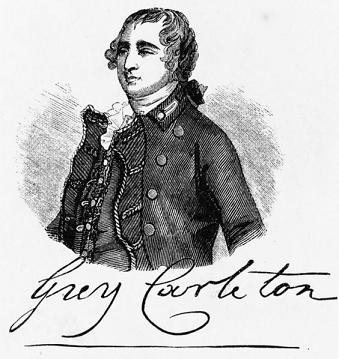
Guy Carleton

In practice, this meant that Carleton remained holed up in Montréal while awaiting events. Carleton had with him a detachment of the 26th Regiment, some Indian Department officers and [Guy] “Johnson’s rangers,” and a small number of Indians. Montréal was a walled city, but Carleton took little comfort in this as the walls were “extensive and defenceless.” The town’s primary defense was its Canadian and English militia. The upper class of Canadians seemed dependable; already a number of these men were serving with the garrison at Fort Saint-Jean. The lower class, however, were at best ambivalent in their sentiments, and quite a few of the English citizens of Montréal had strong ties to the Thirteen Colonies and preferred the American cause.

Meanwhile, Colonel Ethan Allen was heading his way.

Allen distinguished him by co-leading the successful attack on Fort Ticonderoga. However, he afterwards led a meaningless expedition into Canada that almost got him and his command killed or captured [see events of May 17 and May 18, 1775]. (This misadventure in Canada was a primary reason why Allen was bypassed for the leadership of the Green Mountain Boys, when they organized as a regiment in the Continental Army).

A correspondent for the New York Gazette observed that “Allen is a high flying genius, pursues every scheme on its first impression, without consideration, and much less judgment. It was with the utmost difficulty, and through the greatest entreaty, that [Major] General [Philip] Schuyler permitted him to go with the army, knowing his natural disposition…” [2]

Allen's Route to Longue-Pointe: September 18-24, 1775 (click to enlarge).

On September 18, Allen was at Saint-Denis, and contemplated capturing some British vessels anchored at Sorel. On the 20th he was at Saint-Ours, with, he claimed, 250 newly-raised volunteers. He boasted in a letter to Brigadier-General Richard Montgomery that he would raise hundreds, if not thousands, of men, and join Montgomery's army then besieging Fort Saint-Jean. [3] Soon thereafter, Allen marched to Sorel, but made no attempt to capture the British vessels. Instead, his force turned towards La Prairie. Allen could not pay, or feed, or arm his men, and only about 80 left the Richelieu valley with him. Those that did allegedly “plundered the Houses and Farms of the Gentlemen and Habitants, that had joined the King's Forces” “in every Parish on their Road.” [4]

On September 24, Allen’s party left Longueuil for La Prairie, marching along the stretch of St. Lawrence opposite Montréal. En route, he encountered Major Brown. According to Allen, “Col. Brown proposed that, "provided I would return to Longueuil, and procure some canoes, so as to cross the river St. Lawrence a little north of Montreal, he would cross it a little to the south of the town, with near two hundred men, as he had boats sufficient; and that we could make ourselves masters of Montreal."” [5] Allen quickly agreed, picked up 30 Americans that had been with Brown, and returned to Longueuil. His party crossed the river that night and landed in an area known generally as Longue-Pointe. [6]

Notes:

1. Letter to William Legge, Secretary of State for the Colonies, dated September 21, 1775.

2. In Frank Moore (1859). Diary of the American Revolution: From newspapers and original documents.

3. The full contents of Allen's letter can be found here.

4. Here I am quoting a letter by Hector de Cramahé, lieutenant governor of the province of Quebec.

5. From Allen's narrative.

6. As shown in the map, Allen landed in a rural area considerably above the "village" of Longue-Pointe. The landing site was almost certainly within the modern-day Hochelaga-Maisonneuve district of Montréal.

Wednesday, November 3, 2010

Skirmish at Rivière Saint-Jean (3)

This is the third and final post devoted to a skirmish at Rivière Saint-Jean in southern Canada that took place on September 18, 1775. For the events immediately preceding this skirmish, click here. For transcriptions of journal entries recorded by the participants, click here.

On September 17, 1775, the Americans advanced on Fort Saint-Jean, in southern Canada, for the third time. Unlike the earlier attempts (September 6 and September 10), this time the British offered no outward resistance. The Americans took up positions to the south and northwest of the fort, which placed the garrison in a state of siege. Early on September 18th, the British garrison learned of its predicament. Lieutenant William Duff of the 7th Foot was dispatched with about 30 Canadian volunteers to round up cattle from farms north of the fort and to scout out the American position to the northwest. Also, Guillaume de Lorimier, with a few Indians, was sent to scout out the American position to the south.

When Duff returned to the fort, he reported that the American force to the northwest was small, and the fortification it had erected was crude. Major Preston then dispatched Captain John Stronge with around 100 men of the 7th and 26th regiments, with nearly as many Canadian volunteers, and a field piece to drive away the Americans. The force they attacked was much smaller: about 50 Americans and 34 Canadians under the command of Major John Brown.

Brown’s men fired as the British approached, killing Sieur Beaubien dit Desauniers of the Canadians and wounding Corporal Knowles and Private Kelly of the 7th. The British, for their part, fired and charged. This fire possibly wounded several of Brown’s men, who quickly fled into the woods. [1]

British infantry and Canadian volunteers capture a breastwork near Fort Saint-Jean.

Canadian Antoine Dupré was the first man to climb into the breastwork; there he captured a couple of men, including Moses Hazen, a retired British officer and a prominent local landowner.

Hazen had been Brown's prisoner; he was captured the day before while traveling to his fields. However, the British suspected the worst of him and kept him as their own prisoner. The suspicion was deserved. Hazen had secretly contacted the Americans on September 6. On September 11, the British gave him a captain’s commission and orders to raise a company of militia. He did neither.

The British sortie against Brown’s command surprised the American leadership. Brigadier-General Richard Montgomery had intended Brown’s position to remain secret until he could move 500 men into position to support him. However, Brown was defeated before the American movement began. As soon as the sound of musket fire boomed across the flat woodland, Montgomery raced to get his forces into motion.

On the river, the Schuyler and Hancock rowed towards the fort and opened fire with their 12-pounders. This fire reportedly struck a bateau and the British schooner, the Royal Savage, but apparently did no other harm. The British responded with shell fire, but they, too, were unable to inflict casualties.

On land, Colonel Timothy Bedel led around 500 men from Bedel’s Rangers (his regiment), the 4th Connecticut, and the Green Mountain Boys, on a circuitous march through the wet woodland north and west of Saint-Jean. En route, Bedel received conflicting advice: a Canadian guide wanted to take Bedel directly to the site of the earlier skirmish, while a Huron guide wanted to take Bedel further to the east, so as to cut off the British detachment from the fort. Bedel, not understanding the Indian’s intention, and fearing treachery, took the Canadian’s advice.

Skirmish at Rivière Saint-Jean (click to enlarge). The British attack is shown in red. The advance of the American relief force is shown in blue.

The Americans advanced noisily through the woods, and the British opened fire the moment they came into view. According to Lieutenant John Fassett of Vermont, “They gave us a hot fire. The grape shot and Musket balls flew very thick…”

Bedel's Column Forms for Battle.

Benjamin Trumbull (who at the time was in the main American camp), claimed that the British fire wounded two Americans (including a Captain John Watson of the 4th Connecticut), and that a piece of grape shot accidentally killed one Briton (that would be, based on other evidence, Private Alexander Ross of the 26th). Before the Americans could deploy, the British scrambled for the safety of their fort. Bedel then occupied the breastwork Brown had built.

Once again, Fort Saint-Jean was in a state of siege.

Note:

1. See this letter from Major Israel Morey to the New-Hampshire Committee of Safety.

Thursday, September 2, 2010

Carleton Defends Canada

At the time that Ethan Allen and Benedict Arnold captured Fort Ticonderoga and raided Saint-Jean in the province of Quebec [cf. Allen and Arnold: 30 Days to Glory], the only British regulars in Quebec were the 7th and 26th regiments of Foot and two companies of the Royal Artillery. These forces, like all British forces in North America, fell under the command of Lieutenant-General Thomas Gage. Gage, however, was preoccupied by events in and around Boston and he issued few orders to Canada. The important local commanders were the governor of the province of Quebec, Guy Carleton, and Lieutenant-Colonel (and acting brigadier-general), Richard Prescott [1].

The British were aware that the Americans were amassing thousands of men and that they might try to invade Canada and make it a “fourteenth colony.” The British could have sent additional regiments to Canada to turn back the American invasion in the early summer, but this did not occur due to the crisis in Boston and the false hope that thousands of Canadians and Native Americans would fight alongside the British regulars. By the time the American invasion got underway, and the British fully realized their peril, it was impossible to send reinforcements due to the slowness of communications and the worsening weather on the North Atlantic and in the Gulf of Saint-Lawrence.

Carleton knew little about American intentions, but he reasoned there were four routes by which the Americans plausibly could gain entry into Canada. The most likely route, he determined, was via the Richelieu River, which flowed north from American-controlled Lake Champlain in the province of New York. Also possible, though considerably more difficult, was that the Americans would attempt to invade via the Saint-François or Chaudière river valleys, or even along the upper Saint-Lawrence via the western frontier. Carleton therefore placed the greater part of his regulars in the Richelieu valley, kept watch over the other routes, and maintained garrisons in the key towns of Montréal and Québec.

Strategic Situation (click to enlarge).

Key:

British forces are in red, Americans in blue. Totals include all ranks. The French language is used for places in the province of Québec.

A: Fort Saint-Jean on the Richelieu: 390 men of the 7th and 26th Foot (Major Charles Preston commanding), and 44 men of the Royal Artillery

B: Fort Chambly on the Richelieu: 114 men of the 7th Foot (Major Joseph Stopford commanding), and 5 men of the Royal Artillery

C: Rivière Saint-François: 35 men of the 7th and 26th Foot The placement of this force on the map is quite approximate.

D: Rivière Chaudière: 26 men of the 7th Foot. The placement of this force on the map is quite approximate.

E: Oswegatchie: 28 men of the 8th Foot, and 1 man of the Royal Artillery. This post was on the upper Saint Lawrence, to the west of the area shown on the map. The remainder of the 8th was divided among several posts further west.

F: Lachine: 14 men of the 26th Foot. These men guarded a store of gunpowder and other supplies.

G: Montréal: 110 men of the 26th Foot (plus Lieutenant-Colonel Richard Prescott), and 4 men of the Royal Artillery.

H: Québec (ville): 59 men of the 7th Foot, and 6 men of the Royal Artillery.

In addition to these numbers, 11 of the regulars were on furlough and 69 men of the 26th Foot and 4 men of the Royal Artillery were prisoners of the Americans.

In September, American forces advanced along two of the four possible invasion routes:

A: The American army commanded by Major-General Philip Schuyler and Brigadier-General Richard Montgomery that invaded Canada via the Richelieu.

B: American force commanded by Colonel Benedict Arnold that invaded Canada via the Chaudière (shown here first advancing along the Kennebec River in modern-day Maine).

Note:

1. At the time of the Saint-Jean raid, and before Prescott’s arrival, the senior officer was Lieutenant-Colonel Dudley Templer of the 26th; he was no longer with the army at the time of the above dispositions.

Sources:

I'm working from a number of sources, but the above information on troop totals and location comes primarily from the following document:

Friday, July 30, 2010

Fort Saint-Jean

War came to Canada soon after the beginning of the American Revolution. On May 17, 1775 (less than 1 month after the inaugural battle at Lexington and Concord), Colonel Benedict Arnold led a raid against British Fort Saint-Jean in southern Quebec, capturing the personnel, boats, and stores located there. Despite this setback, British governor Guy Carleton did not abandon the post. Instead, Fort Saint-Jean was transformed over the summer of 1775 into the most important point of defense for the province of Quebec.

Fort Saint-Jean was situated at a strategic point in the Richelieu-Champlain-Hudson corridor, a traditional invasion route between the American colonies and Canada. Boats launched from Saint-Jean could sail as far south as Skenesborough, deep within the province of New York (cf. New York: May, 1775). However, no large boat could sail north from Saint-Jean because of nearby rapids in the Richelieu River.

The Richelieu River Valley. Fort Saint-Jean is rendered in English on the map as Fort St. John. The upper part of the Richelieu is labelled River Chambly -- a distinction no longer in use. Note that there were two supply routes connecting Fort Saint-Jean to the rest of Canada. Supplies could be sent by water along the Richelieu, or they could be sent overland from La Prairie (near Montréal).

Fort Saint-Jean was originally constructed by the French of earth and wood, but little remained of those fortifications by 1775. Therefore, the British began from scratch, constructing two earthen redoubts along the river, with a wharf between them. This fort was garrisoned by most of the British regulars in Quebec, including the greater part of the 7th and 26th regiments of foot, and a detachment of Royal Artillery. Others serving at the fort included (French) Canadian volunteers and militia, Scottish emigrants, and Native Americans (the Kahnawake Mohawk were nearest).

The new fort and its garrison were first put to the test in early September, 1775, when an American army, led by Major-General Philip Schuyler and Brigadier-General Richard Montgomery, invaded southern Quebec. These commanders found the fort difficult to approach, for aside from its guns and mortars, much of the surrounding countryside was a vast, flat, swampy woods.

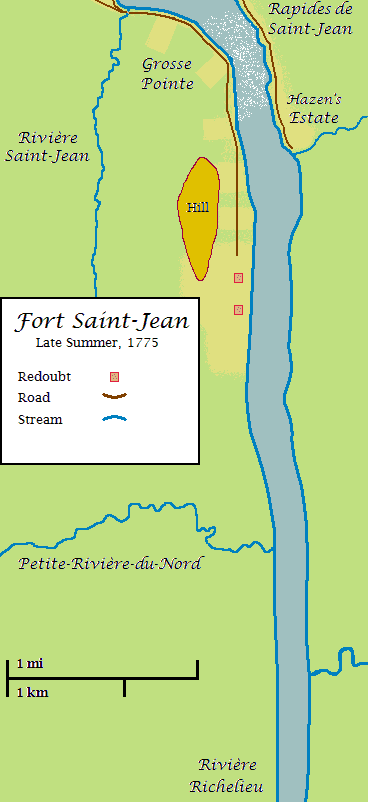
Fort Saint-Jean (click to enlarge). The Americans approached from the south (bottom of the map) via the Richelieu. This map was created by overlaying two early maps of the area on a modern map. The location of the roads and the course of the stream near Hazen's estate are quite approximate. Most difficult to determine was the areas of cleared land (shown on the map in yellow). The approximate dimensions of the cleared area around the redoubts is inferred from several sources. Much less is known about the cleared areas north of the fort; their representation here is speculative. There was likely also some cleared land near Petite-Rivière-du-Nord (at least there was a small house there), but this is not shown for lack of substantive information.

--------------

One of the better descriptions of Fort Saint-Jean appears in the journal of American Major Henry Livingston of the 3rd New York Regiment. He wrote the following (edited to bring the text in line with modern standards for capitalization and punctuation) in an entry dated November 21, 1775:

"The fortress of St. Johns lies near 130 miles north from Ticonderoga on the brink of Lake Champlain and about a quarter of a mile from the first rapid. [Note: Livingston evidently believed that the fort was on an arm of Lake Champlain]. It consists of 2 forts or redoubts near 100 yards asunder. The southern one rather the largest. In this is a brick house containing 2 clever rooms and Lintels back of them-- and a small potash house near it.

"In the north redoubt is a very large white stone house 2 stories high but unfinished within... The forts are about 100 feet wide each way in the inside; and mounted between them, upwards of 30 iron cannon besides brass field pieces (6 pounders) and several mortars.

"The wall is composed altogether of earth, and neatly sodded without, looking as green as the field around it.

"The whole surrounded with a ditch of 7 feet deep and 8 or 9 feet wide--picketed on the interiour side with timbers projecting from under the wall and over the ditch, and a little elevated, with their points made very sharp.

"Between the 2 forts there was a line of pickets placed (or posts) 10 feet high and close together...

"A ditch was also dug deep enough for men to pass unseen thro from one fort to the other, and between the pickets and the lake. Both the pickets and ditch were constructed after we built our eastern battery [i.e., in October, 1775].

"In each redoubt the enemy kept a union [i.e., a flag] displayed.

"It's 2 or 300 yards from the forts to the nearest woods or bushes. In general it's 5 or 600 to the woods--a low plain wet, and covered with excellent grass surrounds the fortress. If there is any elevation of the earth at all, it is where the forts stand.

"The wilderness west of St. Johns is an impassable quagmire--low, wet and covered with timber and brush--and for 7 or 8 miles north [sic, northwest] of the fort we meet with but one sorry log tenement which stood in our grand camp.

"Opposite the forts on the east of the lake the soil is also very wet and low; a perfect howling swamp. There are a considerable number of large hemloc trees [that] grow on this side and plenty of the balm-of-Gilead firs. North east of St. Johns at the distance of about a mile stands a large elegant house belonging to one Captain Hasen [i.e., Moses Hazen] with a considerable quantity of cleared ground around it. The captain has a saw mill standing on the rapids which are just by his house. These rapids are not so great but what rafts of boards and timber can at any time go down them and so into the River St. Lawrence. Our people frequently sent battoes down with cannon in them--and empty ones can be drawn up against the current.

"The fall is perhaps 100 yards in length. The breadth of the lake here as at St. Johns [is] between 3 and 400 yards.

"On the west side of the lake, from St. Johns northward there are settlements all the way to Chamblee [Chambly]; a house or two being in sight of the fort."

Tuesday, June 15, 2010

Allen and Arnold 10

30 Days to Glory: May 18-19
Previous: May 15 - May 17

Thursday, May 18:

Major Charles Preston of the 26th Foot has his men up at an early hour and on the road to Saint-Jean. Ethan Allen had set up an ambush along this road with his Green Mountain Boys, but the British do not walk into a trap. The Green Mountain Boys are mostly asleep. The British open fire upon seeing men in the woods, and amid the rattle of musketry and grape shot, Allen’s men flee to their boats and head upstream. In their haste, however, three men are left behind. As all the British boats have been taken or destroyed, there is no pursuit.

John Brown is in Philadelphia where he meets with the delegates to the Continental Congress and tells them about the capture of Fort Ticonderoga. He is rewarded for bringing this valuable information. George Washington, a delegate from Virginia, contributes 1 guinea.

Brown alarms the delegates by alleging that the Governor of the Province of Quebec, Guy Carleton, is preparing for war. He warns that the British government “means to form an army in Canada, composed of British Regulars, French, and Indians, to attack the colonies...” Afterwards, the Continental Congress passes a resolution that portrays the Green Mountain Boys as would-be victims of British aggression:

“Whereas, there is indubitable evidence that a design is formed by the British Ministry of making a cruel invasion from the Province of Quebec upon these colonies, for the purpose of destroying our lives and liberties, and some steps have actually been taken to carry the said design into execution: and whereas several inhabitants of the northern colonies, residing in the vicinity of Ticonderoga, immediately exposed to incursions, impelled by a just regard for the defense and preservation of themselves and their countrymen from such imminent danger and calamities, have taken possession of that post in which was lodged a quantity of cannon and military stores that would certainly have been used in the intended invasion of these colonies...”

There is some question as to who should take responsibility for the captured lake forts. Neither Connecticut nor Massachusetts wishes to have on this role [cf. May 16 and 17], and New York has been little more than a well wisher to the efforts of its sister colonies [cf. May 2, May 5, and May 12]. The Continental Congress nudges New York along the path toward war by requesting that it take the lead in removing the cannon from Ticonderoga and in establishing “a strong post” to defend them. Like other military measures taken by the colonies to date, these steps are justified by “the overruling law of self-preservation.”

Sunday, May 19:

It is one month since the battle of Lexington and Concord. In Quebec, Governor Guy Carleton receives a letter from Lieutenant-General Thomas Gage describing that battle and requesting him to send the 7th Foot and some companies of Canadians and Indians to Crown Point. Tomorrow Carleton will be shocked when he learns from Moses Hazen of the loss of Fort Ticonderoga and Crown Point and Benedict Arnold’s successful raid on Saint-Jean.

Arnold's flotilla on Lake Champlain ensures that the British cannot quickly recapture the lake forts. However, Arnold is concerned that in time the British will transport bateaus to Saint-Jean and challenge him for mastery of the lake. Captain Eleazer Oswald records that “It is Colonel Arnold's present design that the sloop Enterprise, as she is called, and the schooner Liberty, shall cruise on the lake, and defend our frontiers.”

Arnold ships return to Fort Ticonderoga, where more men of his still-forming regiment await him. Feeling triumphant, he dispatches word to Connecticut and Massachusetts of his success and his intention to begin sending cannon to New England. Arnold does not know yet that his efforts have received little notice nor that the decision has already been made to replace him [cf. May 17]. In the weeks ahead, Arnold will struggle hard, but without success, to retain his command. By his count, 86 guns were taken at Ticonderoga, and 111 at Crown Point. A large proportion are deemed “useless,” but the serviceable guns include big 24-pounder cannon and 13-inch howitzers. Because of command difficulties and various setbacks, it will not be until March of 1776 that the guns from the lake forts will have a decisive impact around Boston.

In the short-term, the capture of the lake forts is seen as another example of British weakness and growing American strength. Such incidents have made the public increasingly bellicose. Only a short time ago, the Ticonderoga expedition was seen as potentially undermining the Americans' claim to moral superiority, and its organizers distanced themselves from the potential fallout [cf. April 27 and April 28]. Now the capture is embraced by the Continental Congress. The changing mood is well expressed in a letter Congressional delegate Benjamin Franklin will write on the 23rd: “…as Britain has begun to use force, it seems absolutely necessary that we should be prepared to repel force by force, which I think, united, we are well able to do. It is a true old saying, that make yourselves sheep and the wolves will eat you; to which I may add another, God helps them that help themselves.”

Monday, June 14, 2010

Allen and Arnold 9

30 Days to Glory: May 15-17
Previous: May 11 - May 14
Next: May 18 - May 19

Monday, May 15:

Benedict Arnold’s expedition departs Crown Point for Saint-Jean. The winds continue to be unfavorable, so Arnold packs himself and 30 men into the bateau and they row hard down the lake. They spend the night at Split Rock, some 15 miles to the north, but far short of their destination. The Liberty is slow to follow, but at least it has the good fortune to intercept a mail boat traveling from Canada. On board is Ensign Joseph Moland of the 26th Foot, who is carrying a document listing all of the British troops in Canada. There are 717 to be exact: far more than the Americans can quickly muster.

James Easton is travelling through Massachusetts to bring word of the taking of Fort Ticonderoga to the Provincial Congress. While en route, he “met several hundred men… on their way to Ticonderoga.” These are very likely men that have responded to Arnold’s call to arms. Whether by design or not, Easton discourages many of these men from continuing onward when he tells them that the fort has already fallen.

Tuesday, May 16:

Benedict Arnold’s command enjoys a favorable wind for a good part of the day. The Liberty makes especially good time and overtakes Arnold in the bateau. The two vessels reach Point Au Fer before becoming becalmed. Arnold is still nearly 30 miles from Saint-Jean, but he is determined to press on as quickly as possible. According to one of his captains, “We immediately armed our two boats, manned them with thirty-five men, and determined, by dint of rowing, to fetch St. John' s, and take the place and the King' s sloop by surprise at break of day.”

The Richelieu River Valley

The Connecticut Committee of Correspondence writes to the Massachusetts Provincial Congress after learning that expeditions from the two colonies, while successful in taking Ticonderoga, came into conflict “about the right to command and hold this important pass.” The Committee feigns ignorance about the origins of the Connecticut expedition, writing that it was “set on foot by some individuals of this colony, in a secret manner.” At least two of the conspirators (Samuel Parsons and Samuel Bishop) are on the committee. Wishing to mend relations, they add, “We consider all the Colonies, and the New-England Colonies especially, as brethren united together in one joint interest, and pursuing the same general design… This is not a time for the Colonies to contend about precedency, but we hope all will wish to put out a helping hand, and mutually afford each other all necessary assistance against our common enemy.”

The Committee is happy to pass off responsibility for the fort to Massachusetts, noting “Some parts of your Province are more conveniently situated to furnish men, etc., for maintaining our possession. We doubt not you will exert yourselves to secure every advantage which may arise from this successful attempt, in which we hope the city and county of Albany, and the colony of Connecticut will co-operate with you, but of this we cannot assure you, as our calls are very many.”

Wednesday, May 17:

Benedict Arnold’s party spend the night “rowing hard” down Canada’s Richelieu River and at sunrise pull into “a small creek” on the western shore [see Note 1]. From there, one man is dispatched to reconnoiter the fort while his comrades wait impatiently amid “numberless swarms of gnats and mosquitoes.” When the man returns he reports that the guards “were unapprised of our coming, though they had heard of the taking of Ticonderoga and Crown Point.” After the canoe arrived with word of the American presence on the lakes, the British commander at Saint-Jean rode to Montreal to obtain reinforcements. The commander is expected back at any time, but for the moment, the outpost is without an officer. Arnold would write, “it seemed to be a mere interposition of Providence that we arrived at so fortunate an hour.”

Arnold’s men then row down to the fort and land a short distance from the barracks. According to Captain Eleazer Oswald, “the men [British soldiers] had their arms, but upon our briskly marching up in their faces, they retired within the barracks, left their arms, and resigned themselves into our hands.” Arnold’s men then proceed to take the sloop, nine other boats, and the military stores on site. In all, Arnold’s men take 1 sergeant and 12 men of the 26th regiment and 7 other men that are with the sloop [see Note 2]. While this is taking place, Arnold meets Moses Hazen, a retired British infantry who has extensive land holdings in the area. Arnold tells him of the capture of the lake forts and brags that he has “command of five hundred men, that volunteers to the amount of fifteen hundred followed him, but he did not wait for them all.”

Arnold has too few men to carry off all of the boats, and so five of the bateaus are destroyed. His expedition sets sail under a favorable wind just 2 hours after their arrival. Arnold sails aboard the sloop, which he renames Enterprise [see Note 3].

About six miles from Saint-Jean, Arnold’s men encounters Ethan Allen’s party. According to Allen, “When I met him [Arnold] with my party… he saluted me with a discharge of cannon, which I returned with a volley of small arms. This being repeated three times, I went on board the [captured] sloop with my party, where several loyal Congress healths were drank.” Allen announces that his men will continue to Saint-Jean, despite the successful conclusion of Arnold’s raid, and that they would “maintain the ground.” Arnold regards this is as “a wild, impracticable scheme,” but Allen remains determined. Arnold then supplies Allen’s men with provisions, “his men being in a starving condition.”

Allen’s men arrive at Saint-Jean that evening. At about 8pm, Joseph Bindon rides into his camp. Bindon is a Montreal merchant that is sympathetic to the American cause. He tells Allen that Major Charles Preston of the 26th Foot is leading a force of 140 men from Montreal to secure Saint-Jean. Allen requests through Bindon that the Montreal merchants supply his men with food, ammunition, and liquor. Allen also sets an ambush in the woods along the road leading to the fort. However, there is no confrontation: Preston camps for the night in the woods some distance away.

In Massachusetts, James Easton “brings the glorious news of the taking of [Ticonderoga] by the American forces without the loss of a man” to the Provincial Congress. He gives the Congress letters by Edward Mott and Ethan Allen written shortly afterwards and he is invited also to state his version of events. Easton elevates himself to a starring role. He claims that after entering the fort, “The commanding officer soon came forth; Colonel Easton clapped him upon the shoulder, told him he was his prisoner, and demanded, in the name of America, an instant surrender of the fort, with all its contents, to the American forces.”

The several accounts that the Provincial Congress receives either do not mention Benedict Arnold or refer to him in only the most scathing terms. Edward Mott's letter complains “Arnold refuses to give up his command, which causes much difficulty; said Arnold not having enlisted one man, neither do we know that he has or could do it… we think that said Arnold' s farther procedure in this matter highly inexpedient…”

Arnold wrote the Massachusetts Committee of Safety on May 10th and 11th. The first letter has disappeared. The second letter will not arrive for another 5 days. With this one-sided version of events, the Provincial Congress decides to divest itself of Arnold. The Congress writes the Connecticut Assembly and extends to them “congratulations… on the reduction of that important fortress, Ticonderoga.” The Congress is “of opinion, that the advantageous situation of that fortress makes it highly expedient that it should be repaired, and properly garrisoned.” They also “should be extremely glad if all the battery cannon, especially brass cannon, which can be spared from that place, or procured from Crown Point… may be forwarded this way, with all possible expedition…” The Congress suggests that Arnold should be responsible for bringing the cannon to Massachusetts, which will end the command controversy while allowing all parties to save face. Like Connecticut, Massachusetts believes that “our common danger ought to unite us in the strongest bonds of unity and affection.”

----------
Note 1: Possibly what was then known as the Petite-Rivière-du-Nord and today is called Rivière Bernier. This small river is about a mile from the fort.

Note 2: According to Arnold's May 19th letter to the Massachusetts Committee of Safety. Guy Carleton (through Moses Hazen) claimed that 1 sergeant and 10 men were taken, and Eleazer Oswald claimed that Arnold took 14 prisoners.

Note 3: The first of a number of famous vessels by that name in American history [wikipedia].