Showing posts with label 16e Agenois. Show all posts

Friday, July 29, 2011

St. Kitts (7): Battle on Land

This is the seventh in a series of post on the St. Kitts campaign of 1782. The St. Kitts campaign took place in what is known as the West Indies theater of the Revolutionary War. [Click for Part 1, Part 2, Part 3, Part 4, Part 5, or Part 6].

The Siege Continues

While the French and British fleets battled south of St. Kitts (Parts 5 and 6), the Marquis de Bouillé continued to attack Brimstone Hill, despite shortages of guns, mortars, and ammunition (cf. Parts 3 and 4). On the 25th, his men opened fire from a new 5-gun battery on Binkes’ Plantation, a little over 1,000 yards to the east, on high ground that was about level with Brimstone Hill. Enough guns and mortars were in action by now to begin inflicting significant damage to the fortress. According to British Governor Shirley:

the enemy [on the 25th] began an incessant fire upon the garrison with their mortars and cannon and continued it till midnight. This day [the 26th] the enemy's fire destroyed the building wherein our whole stock of rum was deposited, and a store which contained a considerable quantity of provisions and arms, and every building on the Hill except two small rooms. [1]

A new wrinkle for de Bouillé was the presence of British infantry with the fleet commanded by Rear Admiral Samuel Hood. To help protect his northern flank, de Bouillé ordered a battery to be erected that would command Fig Tree Bay, north of Sandy Point Town. To help protect his southern flank, de Bouillé placed a detachment at Basseterre.

The British Landing

The British regular army troops with Hood’s fleet included the 28th Regiment of Foot and the flank companies of the 13th Regiment of Foot. These men were commanded by Brigadier-General Robert Prescott and had been temporarily drawn from the garrison on Antigua. Hood also had the services of troops serving as marines for his fleet; these included the 69th Regiment of Foot and two battalions of His Majesty’s Marines.

According to a second-hand account by John Moore, Prescott presented Hood with a couple of options for relieving the British garrison on Brimstone Hill.

General Prescott offered to join and reinforce the garrison with 700 or 800 men if Lord Hood would land him near Charles Fort at the bottom of the hill [i.e., Brimstone Hill], or if he would give him a couple of frigates to land him at the back of the island. Such was his knowledge of the country that he expected to reach Brimstone Hill from thence by by-paths over the mountains, unknown to the French army. Both these proposals Lord Hood rejected, and proposed to the General to land at some distance from Basseterre, as he said, to make a diversion. [2]

Hood’s reasoning was stated in a letter to Prescott, dated January 27th. He wrote:

It appears to me of great importance to the king’s service to possess a post on shore, and I beg to submit it to your serious consideration. I can land two battalions of marines of 700 each, rank and file; the 69th Regiment of 500 rank and file, which, with the troops in the frigates [i.e., Prescott’s men from Antigua], including officers, would make a body of 2,400; and you might have as many guns, 12- and 9-pounders, as you please. It would certainly, I should imagine, make a diversion in favour of Brimstone Hill, and very much distress, puzzle, and embarrass the enemy. [3]

Hood appears to have believed that this force would be too small to raise the siege, but too large for the French to ignore. He saw little risk in this enterprise, he told Prescott, “because your retreat can always be secure.” In other words, Prescott’s men would be defended by the guns of the Royal Navy.

According to Moore, “General Prescott endeavoured to show the absurdity of this.” It seems Prescott felt that Hood’s plan was overly cautious and only a bold move would save the island. However, “His Lordship, as usual, was deaf to reason, adhered to his opinion, and told the General that if he did not choose to land the troops he would land the marines.”

This last part is undoubtedly true; Hood concluded his letter of the 27th by stating that if Prescott did not this plan, “I shall be inclined to land a party of marines to rout the French from Basseterre, [and] hoist the English flag.”

Prescott could not get to shore without the cooperation of the Royal Navy. Therefore, he reluctantly agreed to follow Hood’s proposal.

The troops from the 13th, 28th, and 69th regiments disembarked on the morning of the 28th, and landed on the shore of Frigate Bay. The marines remained with the fleet. According to Captain William Cornwallis of the Canada, the day was marked by fresh breezes and cloudy weather.” [4]

The British Landing (click to enlarge). This map shows the site of the clash on January 28th, 1782 between Prescott and de Fléchin. Also shown is the approximate position of Hood's fleet and de Bouillé's army.

French Forces at Basseterre

The detachment of French troops defending Basseterre was commanded by Le comte de Fléchin, a senior officer in Regiment Touraine [5]. This detachment consisted of the grenadiers and chasseurs from regiments Agénois and Touraine, a portion of Regiment Dillon, and the Volontaires de Bouillé. [6]

Among those stationed near Basseterre was Chevalier de Montlezun, a sous-lieutenant of chasseurs. [7] De Montlezun, still in his teenage years, would later recall tiring days beneath a burning sun and sleepless nights watching for a British attack. His platoon, it seems, dieted chiefly on the fruit of prickly pear plants. These plants abounded on the hills south and east of Basseterre, and one walking across these hills would be tormented by their sharp spines. Nevertheless, according to de Montlezun, the landscape was enchanting. Looking around, he saw green fields of sugarcane surrounded by steep and wild hills, a pale blue salt pond, rows of coconut trees, and a narrow and hilly peninsula, with the ocean lapping on either shore. [8]

It was on this spot that the principal land combat would occur during the St. Kitts campaign and where de Montlezun would have the fight of a lifetime.

When the British infantry landed, de Fléchin moved to confront the British, despite being greatly outnumbered. De Fléchin felt it his duty to delay the British so that de Bouillé would have time to organize a proper defense of the island. De Fléchin left the grenadier company from regiment Touraine and half of his troops from Regiment Dillon to defend Basseterre. The rest were thrown onto the Mooring Hills, southeast of town. From this commanding height they prevented Prescott from moving inland.

Basseterre, Frigate Bay, and the Mooring Hills (click to enlarge). Basseterre town is at left. Frigate Bay is at center (note the three anchors). The Mooring Hills are just to the left of Frigate Bay, and above Great Potatoe Bay.

The French deployment on the Mooring Hills appears to have been as follows: On the right (closest to the sea) was a detachment of 50 men from Regiment Dillon and the 60-man Volontaires de Bouillé, in the center were the flank companies of regiment Agénois, and one platoon of chasseurs from Regiment Touraine, and on the left was the remainder of the Touraine chasseurs (including de Montlezun). The total force numbered around 300 or so men. [9]

The Battle

The three British regiments assembled in column formation on the beach. Around 1pm, General Prescott ordered the 28th and 69th regiments to occupy the Mooring Hills. According to an eyewitness on Nevis, the British regulars “performed this service with gallantry, though their march was all up hill, and through thick shrubs and prickly pears.” [10]

At the same time that the British infantry were ascending the Mooring Hills from the south, de Fléchin was leading a party of men up the northern slope. As the leading British soldiers neared the summit, they unexpectedly “ran against a detachment of… grenadiers and chasseurs running up at full speed” from the opposite direction. The battle had begun. [11]

The British Infantry Land on St. Kitts. From a 1782 painting by François Lescalet. Several frigates are shown disembarking men along the shore. The British form on the beach and advance into combat with de Fléchin's men on the hill at right.

Close up view of British infantry forming on the beach.

De Montlezun and his men were on the British side of the hills when the fighting began. A few British troops were spotted at a dwelling, and de Montlezun was ordered to attack these with his platoon. However, as the chasseurs rushed forward, more and more British troops came into sight, and drew up in a formidable line of battle in an alley of palm trees. De Montlezun’s men would have been slaughtered were it not for the fact that some of the chasseurs on higher ground could see the danger and called for them to come back.

Close up view of chasseurs from Regiment de Touraine. Possibly these men are intended to depict part of de Montlezun’s platoon.

The movement of two British columns up the hill unmasked de Montlezun’s position, and he and his chasseurs began to be shelled by British frigates (they had four in action).

De Montlezun and his men then joined the scramble for control of the hills, where “The musketry fire began at a distance of 10 paces.” He recalled, “Arriving on the line, through a shower of bullets, I had the misfortune to see fall… the valiant Villebrune, second captain of the Agénois chasseurs [12]. The whiteness of his uniform was replaced by a tinge of blood that covered him entirely.”

Close up showing Comte de Flechin rallying the French infantry.

According to the biographer of Chevalier de Mirabeau, then a staff officer in Regiment Touraine, “There were on both sides desperate efforts, furious and repeated counter-attacks… Many times, the French overwhelmed by the number of assailants and shot down by the frigates in the bay, seemed about to succumb,” but the infantry, exhorted by their officers, grimly hung on. De Mirabeau “stood out among those most careless of danger,” until finally “His horse was killed, [and] he was shot in the thigh.” [11]

De Montlezun remembered that “The battle dragged on relentlessly. A mulatto, my company drummer, had the courage to beat the charge for the whole hour that the combat lasted.” De Montlezun admired “the imperturbable coolness” of this drummer, “surrounded by blood and carnage”, who could “expect no reward for his dedication.”

Finally, General Prescott ordered his reserve (the grenadier and light infantry companies of the 13th Foot) to sweep around the French left flank.

“At last,” according de Montlezun, “the ammunition was totally exhausted and,” he wrote with considerable exaggeration, “half of the officers and men had died.” Those still on their feet could not contest the advance of the British reserve, which “was in motion to turn our flank and place us between two fires.”

De Fléchin, realizing that the situation had become hopeless, ordered a retreat. The British had won a strong post near shore, and an open road into the interior.

French losses were about 86 men killed or badly wounded (about ¼ of those engaged). These losses were heaviest in the grenadier and chasseur companies of Regiment d’Agénois. [13]

De Fléchin, although defeated, was lionized for having put up such a stiff fight against the British forces.

British losses were approximately 17 killed, 47 wounded, and 7 missing (71 in total). The 69th Foot reportedly lost 5 officers and 29 men killed and wounded; this loss in officers was one of the highest by a British regiment during the war. [14]

Admiral Hood singled out for praise Lieutenant-Colonel (and New York land baron) Philip Skene, who led the 69th in this engagement. [4]

Notes:

In October of last year, I made a preliminary assessment of this combat and concluded that the fighting probably took place on St. Timothy's Hill. Further research has led me to conclude that the action almost certainly took place on "the Mooring Hills" instead. None of the sources is explicit on this point, but it is the logical conclusion in view of several pieces of evidence. Most important to my way of thinking was a statement by the anonymous journalist on Nevis, who wrote "This day 700 regulars, being all the effectives General Prescott brought down with him, were landed under cover of the frigates at Frigate and Potatoe Bays [both locations are shown on the map above]. The French had a body of men posted on the hills above them..." Further, his description of events following the battle (these will be covered in the next post in this series) makes clear that the battlefield was closer to Basseterre town than St. Timothy's Hill. See Note #10, below, for the full account.

1. Excerpts from Shirley’s journal are from Algernon Aspinall (1915). West Indian tales of old.

2. The diary of Sir John Moore, Volume 1.

3. Charles Middleton (1907). Letters and papers of Charles, Lord Barham, Volume 1.

4. David Hannay (1895). Letters written by Sir Samuel Hood (Viscount Hood) in 1781-2-3.

5. Full name: Charles-François-Joseph de Fléchin de Vamin

6. Attaque et prise de Saint-Christophe dit le «Gibraltar» des Antilles (janvier-février 1782), in Revue Historique des Armées, Vol. 1, 1974. This article includes extracts from «Mémoires Secrets» de Bouillé.

7. Full name: Barthélemi-Sernin du Moulin de Montlezun de la Barthelle

8. Baron de Montlezun (1818). Souvenirs des Antilles. Translations of this work are my own.

9. De Montlezun described himself as being on the extreme left and he reported seeing only white-coated troops from regiment Agénois and Touraine to his right. This leads me to believe that the troops from Dillon and the Volontaires de Bouillé were even further to the right (outside his field of vision), and nearest the British fleet. Admiral Hood was under the impression that the British were fighting Irish troops in French service [cf. Note #4]; however, the detachment from Regiment Dillon was the only set of Irish troops in de Fléchin’s command. The total of “300 or so” is an estimate based on inconsistent statements about de Fléchin’s numbers across several sources.

10. Journal of the capture and recovery of Nevis in Charles Ekins (1824). Naval battles, from 1744 to the peace in 1814.

11. Eugéne Berger (1904). Le vicomte de Mirabeau (Mirabeau-Tonneau) 1754-1792. Translations of this work are my own.

12. Full name: Servant-Paul le Saige de Villebrune

13. Statements about French losses varied slightly from source to source. cf. Note #6, above, the Journal Politique of April, 1782 (seconde quinzaine), and other French accounts of the campaign.

14. See Note #10, above, and the Remembrancer for 1782.

Saturday, July 9, 2011

Uniforms of the St. Kitts Campaign

I'm about halfway through a series of posts on the St. Kitts campaign of 1782 (the most recent post was Part 5). Upcoming posts will focus on a naval engagement on January 26, a land battle on January 28, and the final days of the siege of Brimstone Hill.

As an aside to this series, I discuss in this post the uniforms worn by British and French army regulars during the campaign.

The description that follows touches on only some aspects of the clothing worn by these troops. For a much more complete account, see Philip R. N. Katcher (1973). Encyclopedia of British, Provincial, and German Army Units 1775-1783, and René Chartrand (1991). The French army in the American War of Independence.

British Army

British regulars wore red coats. Individual regiments were distinguished by the color of the coat "facings" (i.e., collar, cuffs, and lapes), by the lace pattern worn around the buttonholes (white with different combinations of colored stripes), and by the metallic color used for officers’ buttons, hat trim, etc. (A copy of the uniform regulations can be found here).

  • 1st (or Royal) Regiment of Foot: Blue facings. Lace pattern was one blue "worm". Officers’ metal was silver.
  • 13th Regiment of Foot: Yellow ochre facings. Lace was worn in pairs; pattern was one yellow stripe. Officers’ metal was silver.
  • 15th Regiment of Foot: Yellow ochre facings. Lace pattern was one mixed yellow and black stripe and one red stripe. Officers’ metal was silver.
  • 28th Regiment of Foot: Bright yellow facings. Lace pattern was one yellow and two black stripes. Officers’ metal was silver.
  • 69th Regiment of Foot: Dull dark green facings. Lace pattern was one red stripe between two green stripes. Officers’ metal was gold.

Perhaps the feature of British army uniforms that is least well understood is the caps and hats worn by the light infantry companies, which were not standardized, and which changed over time. At right is a private of the "picket company" of the 13th Foot, wearing an early version of a light infantryman's cap. The uniform predates the Revolutionary War (by which time picket companies had been replaced by light infantry companies).

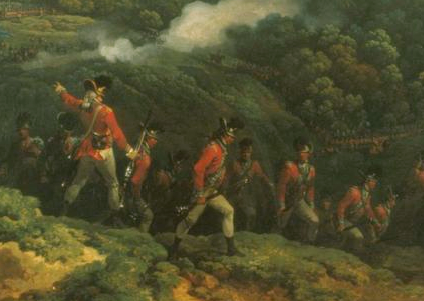
British Light Infantry Officer. This officer, thought to have been with the 15th Foot, is wearing a round hat cocked up on the left side and adorned with a feather. This style of hat would have been worn by the light infantry companies of the 15th and 28th regiments during the Philadelphia campaign of 1777, and possibly retained by these regiments after they were sent to the West Indies in 1778. The light infantry company of the 15th Regiment helped garrison Brimstone Hill fortress.

British Light Infantry on Maneuvers. This section of a painting by Philippe Jacques de Loutherbourg shows what may be the light infantry company of the 69th Foot participating in war game exercises in England, circa 1778. The dark green facings and the style of leather cap match known uniform details for this unit.

French Army

Most regiments of the French regular army wore white coats. Individual regiments were distinguished by the combination of facing color on cuffs and lapels, the orientation of the side pocket flaps, and the color of the buttons.

  • Régiment d'Armagnac (6e): Light blue lapels, vertical pocket flaps, white buttons.
  • Régiment de Champagne (7e): Light blue cuffs, vertical pocket flaps, white buttons.
  • Régiment d'Auxerrois (12e): Black lapels, vertical pocket flaps, white buttons.
  • Régiment d'Agénois (16e): Violet cuffs, horizontal pocket flaps, yellow buttons.
  • Régiment de Touraine (34e): Pink cuffs, vertical pocket flaps, white buttons.
  • Régiment d'Hainault (51e): Crimson cuffs, vertical pocket flaps, white buttons.
  • Régiment Royal Comtois (76e): Blue cuffs, vertical pocket flaps, white buttons.
  • Régiment de Dillon (90e): Red coats, yellow cuffs and lapels, horizontal pocket flaps, yellow buttons set in herringbone fashion. At right is a 1779 illustration of a chasseur of this regiment.

Several units of French colonial troops also participated in the St. Kitts campaign. Régiment de la Martinique wore blue coats without lapels and with buff cuffs and collars. Régiment de la Guadeloupe were dressed similarly, but had crimson cuffs and collars. The Volontaires de Bouillé wore a distinctive "blue short coat" with "red cuffs," and a "helmet" (per Chartrand, 1992). Hussars of the 1st Legion of the Volontaires étrangers de la Marine were also present. These wore a uniform similar to that of the well-known Lauzun's Legion.

Regulation uniforms for grenadiers of regiments Hainault (left) and Touraine (right). Note the facing color is used to line the collar and lapels. The red epaulets and hat tuft identify these men as grenadiers.

Both British and French army units may have modified their clothing in various ways. One well-known example of this in the French case is that some (and possibly many) grenadier companies wore bearskin caps rather than the proscribed cocked hats.

Grenadiers of Régiment de Soissonnois in 1781.

A series of images by Nicolas Ponce suggests that chasseur companies also deviated from the regulated headgear. In these images, the chasseurs are shown wearing a round hat that is cocked in the back and adorned with a feather. This style seems practical; unfortunately, I have not come across any evidence to date that corroborates the accuracy of this depiction.

Chasseurs of Régiment de Dillon at the capture of St. Eustatius in 1781.

Tuesday, May 24, 2011

St. Kitts (2): The Invasion

This is the second in a series of posts, which will appear from time to time, on the St. Kitts campaign of 1782. The St. Kitts campaign took place in what is known as the West Indies theater of the Revolutionary War. For Part 1, click here.

De Grasse Approaches

A French fleet left Port Royal, Martinique, on January 5, 1782, to attack the British isles of St. Kitts and Nevis. The fleet consisted of 25 ships of the line, the 50-gun Experiment, and a number of frigates and transports. Its commander was Lieutenant-General François-Joseph-Paul de Grasse. Because of calms and fog, the ships became strung out over a considerable distance while en route. Most of the fleet reached St. Kitts on the 11th, but some ships did not arrive until the 13th. [1]

The difficulty of the journey was of little importance. The British West Indies fleet (Rear Admiral Samuel Hood commanding) was at distant Barbados.

The French fleet was spotted from St. Kitts and Nevis long before it reached shore. On the afternoon of January 9th (when the French were still 2 days away), Governor Thomas Shirley received word from Nevis “that a large fleet, consisting of about forty sail, twenty-four of which were large ships and the rest sloops and schooners had appeared in sight of that Island.” Shirley was in Basseterre, the principal town on St. Kitts. There he had a cannon fired as an alarm. A detachment of Royal Artillery, and part of the militia, were ordered to defend the coastal batteries. [2]

The British had little in the way of naval resources on hand. One large vessel, the 64-gun Russell, was in port for repairs, but this ship hurriedly departed on the 10th.

As the French fleet slowly drew closer, the British commanders on St. Kitts – Governor Shirley and Brigadier-General Thomas Fraser– had time to rethink the wisdom of defending the entire coast. At last, the two commanders decided to abandon Basseterre and concentrate their forces on and about Brimstone Hill.

On the morning of January 11th, the St. Kitts brigade of militia assembled in Basseterre. Governor Shirley then marched this force along the coastal road towards Brimstone Hill.

At about the same time, a number of merchant vessels in Basseterre got underway and headed north and west, away from the French fleet.

The French Landing

As the French fleet completed the last leg of the journey, it divided into two parts. The main force headed directly for Basseterre, while a secondary force circled around the island and headed for the town of Sandy Point, near Brimstone Hill.

The secondary force consisted of:

  • 1000 men from regiments Dillon and Royal Comtois aboard transports
  • 500 grenadiers and chasseurs aboard two ships of the line, the Experiment, and several frigates. [3]

St. Kitts: January 11, 1782 (click to enlarge).

The French secondary force reached Sandy Point without difficulty, but no landing was made. The approaches to Sandy Point were defended by two coastal batteries, and the British were in force on nearby Brimstone Hill. Instead, the French attacked the merchant vessels which were streaming along the shore. The merchant vessels hurriedly took shelter under the guns of Brimstone Hill. According to Shirley, some of the merchant vessels were saved from capture “by a well-directed fire from our line of batteries” and “the merchantmen got shelter under the guns of Brimstone Hill and [nearby] Fort Charles.” Nevertheless, the French captured at least 27 vessels. [4]

The French secondary force also spotted the St. Kitts and militia on their march and opened fire. Shirley wrote that the militiamen were “very much annoyed” by the French ships, but the fire did not prevent them from reaching Brimstone Hill.

The main French force, under de Grasse, approached Basseterre and saw that the battery defending the town appeared to have been abandoned. A 60-man company of colonial troops (the Volontaires de Bouillé) approached the fort in two boats, supported by two frigates. When the company found that the battery was undefended, they hoisted the French flag. At about the same time, a delegation of citizens from Basseterre approached the French fleet in a small boat and informed the French that the British had retired to Brimstone Hill and that those who remained behind would offer no resistance.

Meanwhile, the secondary force joined the main fleet at Basseterre, and at about 6pm, the French infantry began to disembark. The French commander, the Marquis de Bouillé, had his troops assemble in four divisions on the shore. They were organized as follows:

  • Colonel de Dillon’s division: Regiments Dillon and Royal Comtois, two companies of grenadiers from Regiment Martinique, and a detachment of Volontaires Étrangers de la Marine (perhaps 1,500 effectives in total).
  • Maréchal de Saint-Simon’s division: Regiments Agénois and Touraine (about 2,000 effectives).
  • Brigadier de Damas’ division: Regiments Auxerrois and Champagne (about 1,200 effectives).
  • Brigadier du Chilleau’s division: Regiments Armagnac (2 battalions), Viennois, and Guadeloupe (perhaps 2,100 effectives). [5]

The disembarkation and assembly proceeded smoothly, and at 9pm Dillon’s division began marching towards Brimstone Hill. The rest of the troops followed 30 minutes later. De Bouillé intended to surround the British fortress under cover of darkness.

Left to right: Grenadiers of Armagnac, Auxerrois, and Viennois. These illustrations show what was essentially the uniform worn by these regiments on St. Kitts; one difference is that the French grenadiers generally wore a tall bearskin cap rather than the cocked hat shown here.

Notes:

1. An invaluable source on French naval operations is John Gilmary Shea's (1864) The Operations of the French Fleet Under the Count de Grasse in 1781-2 as Described in Two Contemporary Journals.

2. Extracts of Shirley’s journal, including that quoted here, appears in Algernon Aspinall's (1915) West Indian Tales of Old.

3. From Attaque et prise de Saint-Christophe dit le «Gibraltar» des Antilles (janvier-février 1782), in Revue Historique des Armées, Vol. 1, 1974. This article includes extracts from «Mémoires Secrets» de Bouillé. A detailed description of de Bouillé’s operations also appears in the Journal Politique of April, 1782 (seconde quinzaine).

4. R. de Kerallain (1928). Bougainville à l’Armée du Cte de Grasse. Journal de la Société des Américanistes de Paris, 20, 1-70.

5. French sources generally claim that they fielded an army of 6,000 men; British sources attribute to the French 8,000 men. I suspect the latter number is more accurate. One French account claims they had “6000 hommes effectifs & de 800 volontaires de la Martinique,” which I take to mean 6,000 effectives of the Metropolitan Army and 800 colonial troops that had been stationed on Martinique. Colonial troops known to have participated in this campaign included Regiment de la Guadeloupe, two companies of grenadiers from Regiment de la Martinique, and the company-sized Volontaires de Bouillé. If one counts soldiers of all ranks, the French army would have totaled well above 7,000 men. De Bouillé only partially identified the size of each of these divisions; I relied on a certain amount of extrapolation to determine the approximate size of Dillon’s and du Chilleau’s divisions. De Bouillé’s exact language in describing the composition of his forces (and how he intended to place them around Brimstone Hill) is as follows:

“La division du Marquis de Saint-Simon, composée de deux mille hommes, des régiments de Touraine et d'Agénois, dut prendre la droite, et se placer entre la vieille rade et Brimstone-Hill, le plus près possible, cependant hors de la portée du canon de la place. Celle du Vicomte de Damas, composée de douze cents hommes, des bataillons d'Auxerrois et de Champagne, à la gauche de la première, pour garder les debouches des montagnes. Celle du Comte Arthur Dillon, compose de 1.200 hommes, des bataillons de Dillon, de Royal comtois, et de deux companies de grenadiers de la Martinique, et les volontaires étrangers de la marine, fut à la gauche de celle de M. de Damas, pour le même objet et pour communiqué avec elle. Celle du Marquis du Chilleau, compose de deux bataillons d’Armagnac, d’un de Viennois, d’un de la Guadeloupe dut être à la gauche de celle de M. de Dillon, et occupier Sandy-point.”

Thursday, October 28, 2010

Combat on Kitts

One of the most remarkable images of Revolutionary War combat is a naïve-art painting of a skirmish on the island of St. Kitts on January 28, 1782. This is a very rare instance of a combat painting by a Revolutionary War soldier, created during the war. The artist was one François Lescalet, who served on the French warship Le Sceptre. The painting shows French infantry defending a hill against disembarking British infantry.

Two sections of this painting are shown below. A zoomable version of the painting can be found here.

British troops disembark on the island of St. Kitts (click to enlarge). Possibly (see analysis below) the column at left is comprised of troops from the 13th Foot, while the column at right is comprised of troops from the 69th Foot.

Comte de Flechin leads the defense (click to enlarge). Comte Charles-François-Joseph de Flechin, on horseback, is either rallying his troops, or sending men into action. At left, smoke-enshrouded regulars skirmish with the enemy.

Overall, the painting shows chiefly land and sky. The figures are small and vague, and the heavy smoke obscures the action. Nevertheless, a number of features stand out.

British Troops

The British form on the beach directly into columns, and the new arrivals take their place at the end of the column. The columns are formed two abreast, either because of the narrowness of the roads or to facilitate quick deployment into line. Three columns are shown, which seemingly correspond with the three infantry units known to have participated in this action: the flank companies of the 13th foot, the battalion companies of the 28th foot, and the 69th regiment. The first two of these wore yellow facings, the third wore dull green facings. Drummers in yellow can be seen alongside the left two columns. The visible facing colors, numbers of drummers, and length of each column suggest that the troops are, from left to right, those of the 28th, the 13th, and the 69th regiments. However, Lescalet may have chosen yellow as the facing color simply because it was common in the British army, and he may have varied the column length for other reasons.

French Troops

Flechin’s command included the chasseurs and grenadiers of regiments Agénois and Touraine, among others. It is not possible to discern which men belong to which regiment as the figures have not been given facing colors. The French troops are shown meeting the British near the base of the hill, suggesting that Flechin intended to fight a delaying action, slowly giving way, while still retaining the high ground. The French troops are not shown deployed as a single line, but rather as a cluster of small parties. This deployment makes sense in view of the difficult terrain.

Location

The action appears to be taking place on St. Timothy’s Hill, which is in the southeastern quarter of St. Kitts, on the edge of Frigate Bay. A comparison with modern photographs suggests that Lescalet painted a location that he had visited and remembered.

Section of the Lescalet painting.

Google Maps screenshot with the Panoramio images feature enabled (the image has been cropped). The photo was taken from St. Timothy’s Hill, looking south, and shows much of the same terrain visible that is visible in the Lescalet painting.

Outcome

The outcome of this skirmish on St. Kitts is in dispute. Francophile and Anglophile writers have claimed this as a decisive victory for the French and British, respectively. Two examples appear below:

John William Fortescue in A History of the British Army, Vol. 3 (1902):

"... Prescott [the British infantry commander] and his troops were able to land on the 28th. He was at once attacked by the French, who, however, were repulsed without difficulty."

René Chartrand in American War of Independence Commanders (2003):

"... on January 28, 1782, the British landed a relief force. Flechin, with a party of 300 men, charged the head of the British column. The stunned British re-embarked. Brimstone Hill [i.e., the British garrison on St. Kitts] surrendered on February 12 and Nevis also capitulated largely because of Flechin's outstanding action."

The truth, as far as I’ve been able to discern, lies somewhere between these statements. The British drove de Flechin’s small force off the hill, but the aggressive defense prevented the British from achieving any strategic advantage. The campaign for St. Kitts has been the subject of some recent reading on my part, and possibly it will serve as the topic for a future series of posts.

Wednesday, October 20, 2010

Régiment d'Agénois

Organization

Like other French infantry regiments, Agénois consisted of two battalions (both of which served in America). Each battalion consisted of 1 grenadier company, 1 chasseur company (their equivalents in the British and American armies was light infantry), and 4 fusilier companies.

Service

One battalion of Régiment Agénois was dispatched from France to the West Indies in October, 1777. There, the battalion helped garrison the island of Guadeloupe. In 1779, a portion of the troops was placed aboard Comte d’Estaing’s fleet and participated in the siege of Savannah. There, the detachment participated in the bloody assault on the Spring Hill redoubt (October 9, 1779). Afterwards, the men from Agénois were disembarked on the isle of Grenada in the West Indies. In 1781, the battalion was reunited on Martinique, and later, sent to Virginia where it participated in the siege of Yorktown. After the British surrender, the battalion was returned to Martinique, and in January, 1782, Agénois contributed to the siege of Brimstone Hill on St. Kitts. There, on January 18, the grenadiers and chasseurs of Agénois, along with those of Touraine, were attacked at Basse-Terre by a large relief force disembarked from a British fleet. The French companies were able to contain the British landing until reinforcements arrived, and this helped bring about the eventual surrender of the British garrison on Brimstone Hill. The troops from Agénois then served aboard the French fleet that was defeated at the battle of The Saintes (April 9 and 12, 1782). Most of the fusiliers were lost: those aboard L’Hector were captured by the British navy, and those aboard Le César perished when the ship exploded.

Uniforms

At the time France entered the war, Agénois wore a uniform white coat with pink cuffs and lapels, and a green collar. A new set of uniform regulations was issued in 1779, although the older uniforms were not immediately discontinued. Under the new regulations, the regiment wore a white coat with violet cuffs. Violet also trimmed the collar, lapels, and pocket flaps, which were white. The new regulations replaced the tall bearskin caps the grenadiers traditionally wore with a three-cornered hat decorated with a red pompom.

The contemporary drawing below shows an Agénois fusilier in the 1779-regulation uniform (excepting the plume, which was a feature of the older uniform).

There is reason to doubt that Agénois strictly adhered to the new regulations. The grenadiers, for example, appear to have retained the bearskin caps. Baron de Montlezun, in his Souvenirs des Antilles (1818) compared a conical-shaped plant found in the West Indies to the caps worn by the Agénois grenadiers (among others) during the American Revolution:

“Je voudrais pouvoir détailler au botaniste la variété des plantes que je foulais aux pieds; celle qui me frappa davantage, que je ne me rappelais point d'avoir vue, et que j'ai baptisée bonnet de grenadier, est une espèce de raquette, en masse demi-ovale, ou cône arrondi au sommet, façonnée dans son contour en côtes hérissées de piquans. L'ensemble a la dimension et la forme exacte d'un bonnet de grenadier surmonté d’un panaché si minutieusement ressemblant par ses proportions, sa teinte rouge-vif, et la place qu'il occupe sur cette plante, à ceux dont se décorent nos premiers soldats d'élite, que je fus saisi d'étonnement à un point que je n'ai jamais éprouvé, et que je ne pus m'empêcher de songer tout de suite aux braves grenadiers d'Agénois et aux nôtres, qui en portaient de pareils sur leurs têtes. Quelques-unes de ces plantes ont plusieurs pompons, mais le plus souvent elles n'en ont qu'un seul d'un beau rouge et de superbe effet!”

Another discrepancy is that the supposedly violet color of the cuffs may have been closer to blue in practice. Bluish cuffs can be seen in the paintings below by Blérancourt and van Blarenberghe. Of course, this could also reflect an error on the part of the painters, or a change in the color of the paint over time. However, René Chartrand, in The French Army in the American War of Independence (1991), refers to one source at Yorktown describing a French regiment wearing “white coats turned up with blue,” which could only be the supposedly violet-clad troops from Agénois or Gâtinais.

Detail from a Blérancourt painting showing a fusilier of Régiment Forez (left) and grenadier of Régiment Agénois (center). Both regiments purportedly had violet facings. The grenadier is wearing the regulation hat with pompom.

Details from the van Blarenberghe paintings of the siege of Yorktown. The marked grouping in the left panel shows officers (from left to right) from 104e Deux-Ponts, 18e Gâtinais, and 16e Agénois. The facings of the latter two appear to be bluish. The soldiers in the right panel are from 13e Bourbonnais, 18e Gâtinais, and 16e Agénois. Again, the facings of the latter two appear bluish. Note the bearskin cap on the grenadier.